
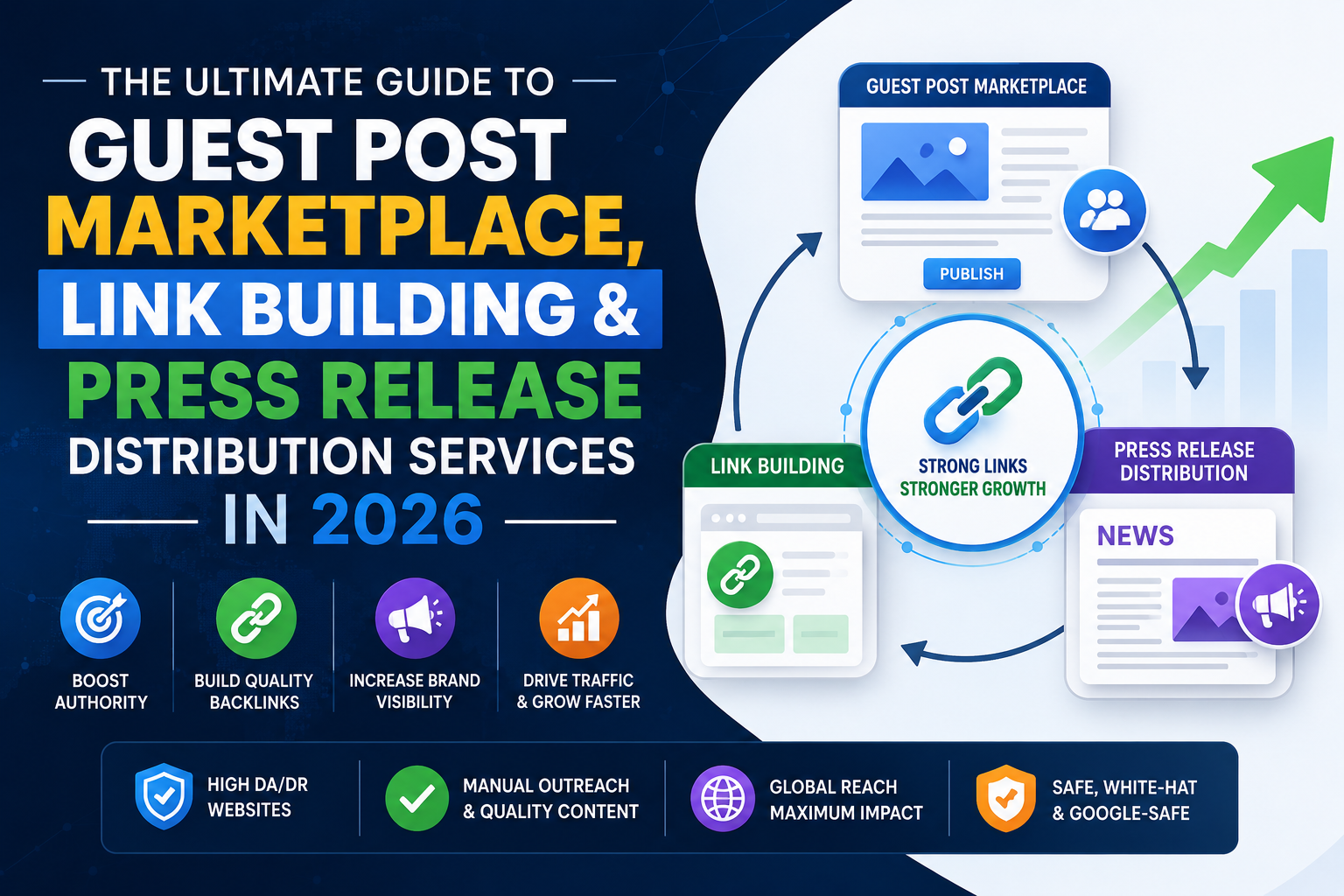
If you have been running a website for any reasonable length of time, you already know this truth: content alone will not rank you. Google does not just read your words — it reads the signals other websites send about you. And the strongest signal of all? A backlink from a real, relevant, high-authority site.
This is exactly why guest posting, press release distribution, and link building services have moved from “nice to have” to an absolute requirement in any serious SEO strategy. But the challenge most marketers face is not understanding why these work — it is knowing how to execute them without wasting thousands of dollars on low-quality placements, spammy directories, or outreach agencies that vanish after taking your money.
In this guide, we break down everything you need to know — from choosing the right guest post marketplace to understanding what separates a press release that actually drives traffic from one that disappears into the void. Whether you are an SEO agency, a startup founder, a freelancer, or a digital marketer managing multiple client campaigns, this is the most practical resource you will find on the subject in 2026.
What Is a Guest Post Marketplace — And Why Does It Matter?
A guest post marketplace is a platform that connects two parties: website owners (publishers) who are willing to accept guest content, and SEO professionals or brands (buyers) who want quality backlinks from those sites. Rather than spending weeks cold-emailing site owners and getting 95% ignored, a marketplace gives you a curated, searchable database of verified publishers — all with transparent metrics so you know exactly what you are buying before you commit a single rupee or dollar.
What a proper guest posting marketplace shows you:
- Domain Authority (DA) and Domain Rating (DR) — so you can choose links that actually move the needle
- Organic traffic figures from Ahrefs or Semrush — because a DA60 site with zero traffic is worthless
- Niche relevance — critical for topical authority in Google’s eyes
- Turnaround time — how long before your post goes live
- Pricing — with no hidden fees or surprises at checkout
- Google News status — a strong trust signal for press releases and news-adjacent content
The difference between using a guest posting marketplace and doing manual outreach yourself is roughly 40 hours of work versus 4 hours of work to achieve the same number of quality placements. For agencies managing 10+ clients, that calculation is the difference between profit and burnout.
Guest Posting Services: What You’re Actually Paying For
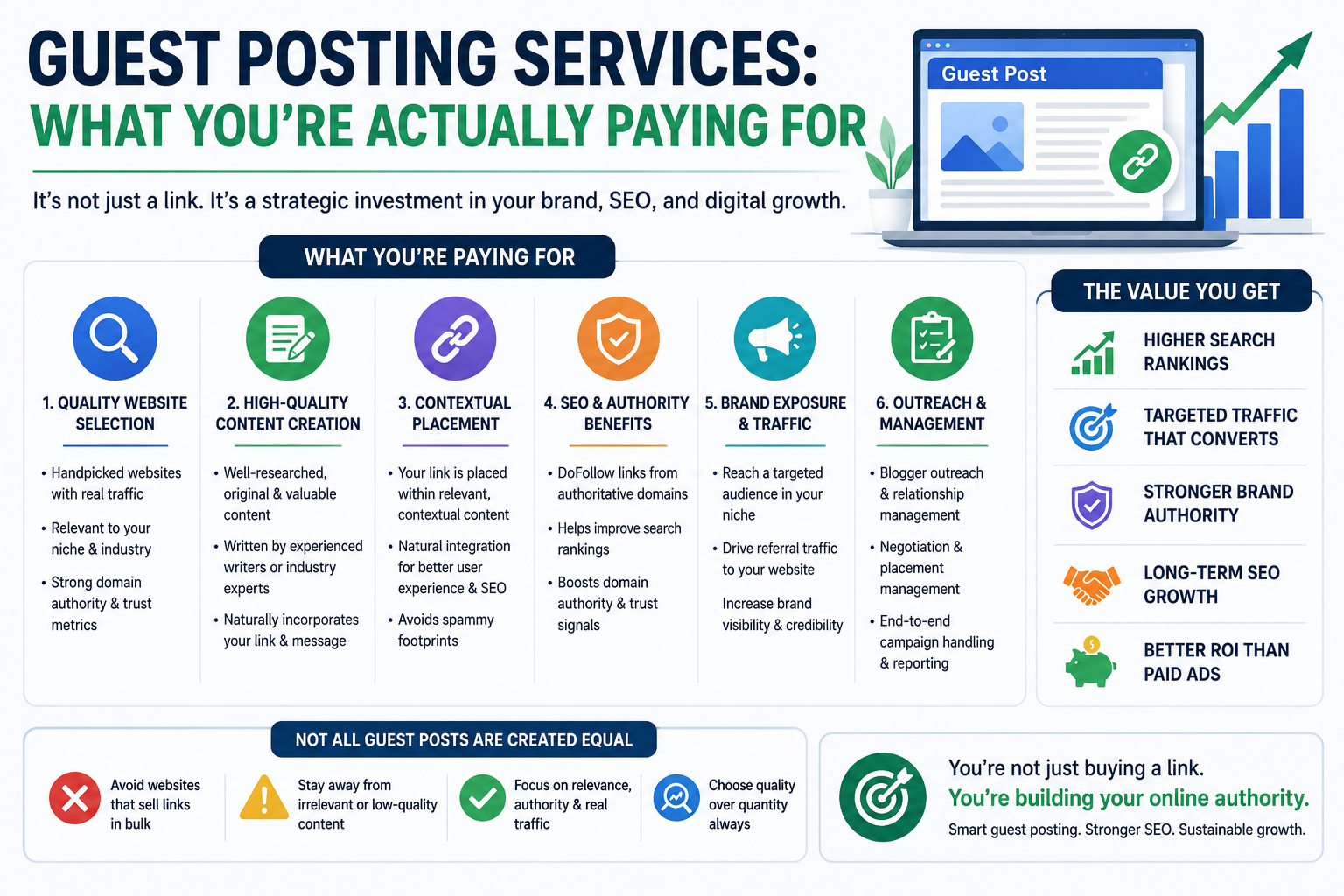
When people search for guest posting services, they often imagine a simple transaction — pay someone, get a backlink. The reality of a quality service is far more layered, and understanding what is involved helps you avoid getting ripped off by low-effort providers.
Here is what a genuine guest posting service actually includes:
a) Publisher Vetting
Not all websites that accept guest posts are worth your investment. A real service filters out private blog networks (PBNs), sites with manual Google penalties, sites that exist purely to sell links with no real content or audience, and domains with suspiciously spiked or fake traffic. The vetting process is continuous — what was a clean site six months ago might not be today.
b) Content Creation
Most buyers either submit their own article or have the service write one. The content has to be genuinely useful and topically relevant to the host site — not keyword-stuffed filler designed to fool a moderator. Google’s Helpful Content System is increasingly capable of detecting content written purely for link insertion, and publishers get penalised when too many such posts go live on their site. Quality article writing that passes both human editor review and algorithmic scrutiny is a skill that cheap providers consistently underdeliver on.
c) Anchor Text and URL Management
Over-optimised anchor text is one of the fastest ways to trigger a manual penalty. A competent guest posting service helps you diversify anchor text — balancing exact-match, partial-match, branded, and naked URL anchors — so your link profile grows naturally over time and does not look manufactured to Google’s spam detectors.
d) Live URL Reporting
Every placement should come with a live URL and verifiable metrics. If a service cannot show you exactly where your link appeared and what metrics the page carries, that is a red flag. The best platforms provide white-label reports that agencies can send directly to their clients.
How to Buy and Sell Guest Posts the Right Way
The buy and sell guest post model has matured significantly. What used to be a fragmented, trust-based arrangement between individual bloggers has become a structured marketplace economy — with both sides benefiting when the platform does its job properly.
For Buyers
When you buy guest posts through a marketplace, your workflow should look like this:
- Filter by niche first — relevance is more important than raw DA in 2026
- Check traffic independently (paste the site into Ahrefs or Semrush separately to verify)
- Review the site’s existing content — is it real writing by real people, or obvious link farm filler?
- Check for sponsored/guest post disclosure practices — some niches have stricter rules
- Order with content or submit your own — ensure the article passes plagiarism and quality checks
- Follow up on live URLs and track rankings of your target pages in the 60–90 days post-publication
For Sellers (Publishers)
If you own a website with real traffic and good authority metrics, listing it in a guest posting marketplace is one of the most passive income streams available to content publishers. You set your price, your niche, your content standards, and review submissions before they go live. You stay in control — you just get paid for the value your domain already carries.
The key to sustainable seller income is maintaining your site’s quality — accepting every paid guest post regardless of content quality will erode your DA and traffic over time, which eventually reduces what buyers are willing to pay. Treat it as a publishing business, not a link farm.
Link Building Services: The Bigger Picture
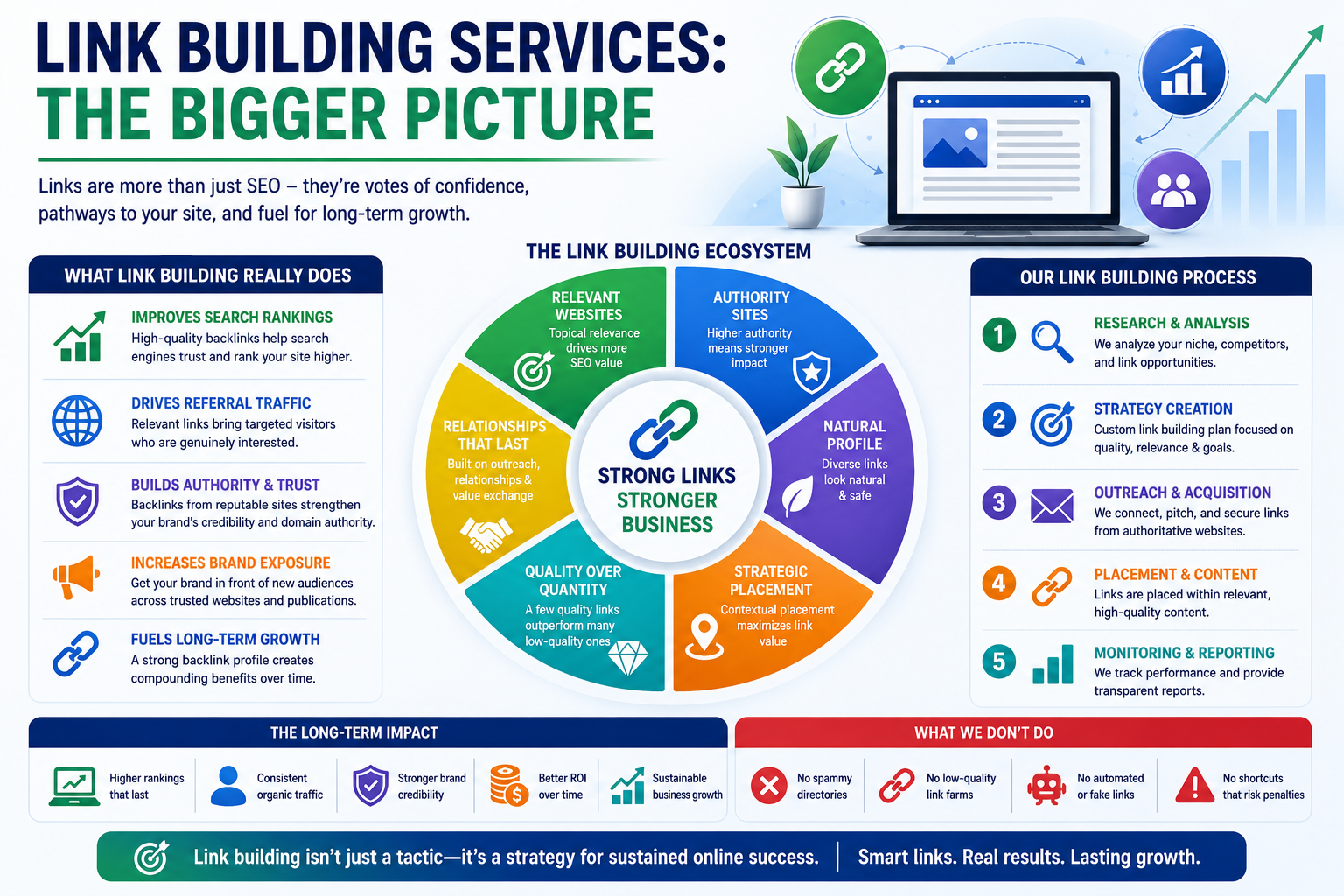
Guest posting is one of many link building strategies. A mature SEO campaign typically uses multiple approaches simultaneously, and understanding how they fit together is what separates campaigns that plateau at page 2 from those that consistently break into the top 3 positions.
The core link building methods worth your budget in 2026:
Guest Posts (Contextual Backlinks)
New articles published on third-party sites with a contextual backlink to your target URL. Strong for building topical authority and anchor text diversity. Works best when placements are on genuinely relevant sites rather than just high-DA generalist domains.
Niche Edits (Link Insertions)
Placing your link inside existing, already-indexed content on third-party sites. Because the page already has history and real traffic, these links often carry more immediate weight than links in freshly published guest posts. Particularly effective for competitive keywords where you need faster results.
Press Release Links
Distributed through newswire services, press releases earn mentions and links from news sites, financial portals, and media platforms. These are typically no-follow but carry significant brand authority signals. When a press release gets picked up by genuine journalists and covered editorially, those editorial links are among the most powerful you can earn.
Local Citations
For businesses targeting local search results, consistent NAP (Name, Address, Phone) listings across authoritative country-specific directories are non-negotiable. Google uses citation consistency as a local ranking signal — even a phone number formatted differently across directories can suppress your rankings in the map pack.
The most effective link building campaigns treat these not as separate tactics but as layers of the same strategy — guest posts for topical authority, niche edits for speed, press releases for brand signals, and citations for local presence.
Press Release Distribution Services: When and Why to Use Them
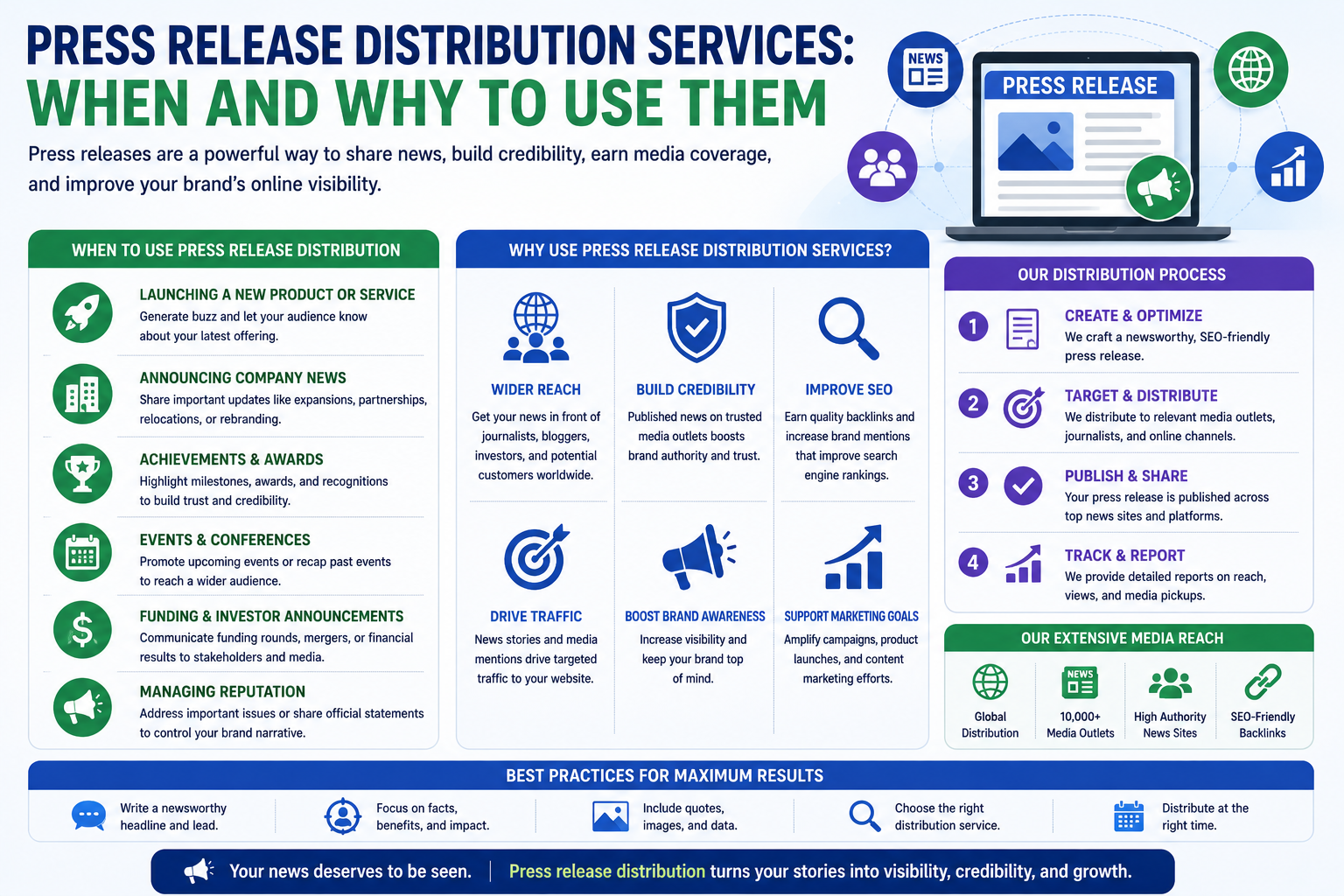
Press releases are one of the most misused tools in digital marketing. Done well, they drive brand visibility, earn mentions across hundreds of credible media platforms, and send powerful trust signals to search engines. Done poorly — with thin, self-congratulatory content pushed to irrelevant wire services — they are a waste of money and occasionally a source of toxic links.
A press release is worth distributing when:
- You are launching a new product, service, or feature with genuine market relevance
- You have received funding, an award, or a partnership worth announcing publicly
- You are entering a new market or geographic region
- You have a data study, research finding, or industry report that journalists would want to reference
- You are running a major campaign, event, or initiative with public interest value
What separates a premium press release distribution service from a basic one is reach and relevance. A starter distribution might push your release to 50 syndication partners. An enterprise-tier distribution places it in front of thousands of outlets, including industry-specific publications, regional news platforms, financial sites, and Google News-approved sources — each one contributing to a wider brand footprint in SERPs.
One often-overlooked benefit of press release distribution is that it generates what SEOs call PR signals — multiple authoritative sources referencing your brand name and URL within a short time window. This pattern is associated with brands that Google classifies as legitimate, authoritative entities, which can give your overall domain a measurable trust boost.
Common Mistakes That Kill Guest Posting ROI
Even marketers who understand guest posting conceptually make execution errors that reduce or eliminate the expected return. Here are the most common ones to avoid:
Prioritising DA Over Traffic
Domain Authority is a third-party metric, not a Google signal. A site can have a DA of 45 with 200 monthly organic visitors — meaning Google barely indexes it and real humans almost never see it. Always cross-check traffic independently, and prioritise sites with real, consistent organic traffic over sites with inflated DA.
Using the Same Anchor Text Repeatedly
If 40% of your backlinks all use the phrase “buy guest post” as anchor text, that pattern looks unnatural and manufactured. Google’s Penguin algorithm targets exactly this kind of over-optimisation. Vary your anchors deliberately — branded terms, partial matches, generic phrases, and bare URLs should all appear in your backlink profile.
Buying in Bulk from PBN Networks
Private Blog Networks can produce short-term ranking lifts that vanish the moment Google identifies the network and issues a manual action. A single Google algorithm update can wipe out years of rankings built on PBN links. White-hat placements on real sites with real audiences carry zero devaluation risk and compound in value over time.
Ignoring Topical Relevance
A backlink from a tech blog to a fitness website is not as valuable as a backlink from a fitness blog to the same fitness website. Google has become significantly better at understanding topical context, and links from thematically related sites carry substantially more ranking weight than links from unrelated high-DA domains.
Publishing Once and Stopping
Link building is not a one-time project. Your competitors are building links every month. If you run one campaign, see a ranking improvement, and then stop, you will gradually lose ground to competitors who maintain consistent monthly acquisition. Treat link building the way you treat content — as an ongoing investment, not a one-off sprint.
How to Choose the Right Guest Posting Platform in 2026
The market for guest posting services has expanded dramatically, which means more choice but also more noise. When evaluating platforms, here are the specific questions that separate professional-grade marketplaces from low-quality providers:
Publisher Verification
Does the platform manually verify that listed sites have real traffic and are not PBNs? How frequently are site metrics updated?
Transparency of Metrics
Can you see DA, DR, organic traffic, niche, language, and pricing all in one dashboard — or are key metrics hidden behind a pay-first structure?
Content Standards
Does the platform enforce editorial quality — requiring that articles meet a minimum word count, pass plagiarism checks, and provide genuine value to the host site’s readers?
Turnaround Time
What is the average delivery window? Reputable platforms can deliver most placements within 3–14 business days. Be sceptical of anyone promising next-day links across high-DA sites.
White-Label Reporting
If you are running an agency, can you produce client-facing reports without exposing your supplier?
Refund and Revision Policy
What happens if a site goes offline, loses traffic, or removes your link after publication? A serious platform stands behind its placements.
Scale
Can the platform handle a campaign of 50, 100, or 500 links per month without quality dropping? Some providers are excellent at small-scale but fall apart at volume.
SEO Agencies: Why Reseller-Friendly Link Building Matters
If you run an SEO agency, your core competency is strategy and client management — not running outreach campaigns at scale. Partnering with a white-label link building service lets you deliver consistent, high-quality backlinks to your clients without building an in-house outreach team, maintaining a publisher database, or spending your team’s billable hours on execution.
What to look for in a reseller partnership:
- White-label reports with your branding, not the supplier’s
- Bulk pricing that allows a healthy margin when reselling to clients
- Dedicated account management rather than a generic support ticket system
- Consistent quality at scale — the 50th link delivered should be as strong as the first
- Confidentiality — you do not want clients discovering your supplier and going direct
Agencies that have integrated white-label guest posting and link building into their service stack consistently report higher client retention — because rankings improve, clients can see the results clearly, and the campaign builds something durable that clients can observe month over month.
What Google’s 2026 Algorithm Updates Mean for Guest Posting
Every year, a wave of “guest posting is dead” content appears online. Every year, the rankings of sites that do guest posting well prove that claim wrong. What has changed — and continues to change — is the bar for what constitutes quality.
Google’s Helpful Content System update has made it significantly harder for content-thin sites to rank — including sites that primarily exist to host paid guest posts. This is actually good news for buyers, because it means low-quality link farms are losing their authority naturally, and the sites that remain competitive are sites where real people read and engage with content.
E-E-A-T (Experience, Expertise, Authoritativeness, and Trustworthiness) continues to be a core quality signal. Guest posts that demonstrate genuine expertise on a topic — written by a named author with verifiable credentials or a history of quality content — carry more weight than anonymous filler posts. If you are writing content for your guest post campaigns, invest in making it genuinely expert-level, not just optimised.
The bottom line: guest posting in 2026 is not harder — it is more clearly meritocratic. Quality placements on quality sites with quality content produce quality results. The shortcuts have mostly been closed off. The fundamentals have never been more reliable.
Building Your Link Profile: A Practical Monthly Framework
Rather than thinking about guest posting as individual transactions, the most effective approach treats link building as a monthly programme with defined inputs and measurable outputs. Here is a framework that works across industries:
Month 1 — Foundation
- Audit your current backlink profile using Ahrefs or Semrush
- Identify your 5–10 most important target pages (highest commercial intent, closest to ranking)
- Purchase 5–10 guest posts on DA30–50 niche-relevant sites targeting those pages
- Run 2–3 niche edits for faster indexing and quicker ranking signals
- Issue a press release if you have a newsworthy company announcement
Month 2 — Acceleration
- Review ranking changes for target pages — identify which are moving, which are stalled
- Increase link velocity on the highest-potential pages
- Diversify with DA50–70 placements for the most competitive keywords
- Begin local citation building if geographic relevance is part of your strategy
- Add a supporting blog cluster internally to support the pages receiving backlinks
Month 3 and Beyond — Compounding
- Maintain a steady acquisition rate of 10–20 quality links per month
- Rotate anchor text continuously — never let any single anchor exceed 20% of your profile
- Monitor competitor backlink acquisition and respond to their high-value placements
- Track organic traffic, not just rankings — rankings are a leading indicator, traffic is the real outcome
- Review and refresh content on your highest-traffic pages every 6 months to sustain rankings
Final Thoughts: Why a Guest Post Marketplace Changes the Game
The core value proposition of a professional guest posting marketplace is time and quality at scale. Manual outreach — even when done expertly — is slow, unpredictable, and resource-intensive. A well-built marketplace gives you access to hundreds of verified, niche-relevant publishers, transparent metrics, and a streamlined ordering process that turns weeks of outreach work into hours of campaign planning.
Whether you are buying your first guest post or managing a link building programme for 30 clients, the principles remain the same: relevance over raw metrics, quality over quantity, consistency over sprints, and transparency over promises.
The websites ranking in position 1 today almost certainly have a deliberate, well-managed backlink strategy behind them. The question is not whether link building works — the evidence on that is settled. The question is whether your strategy is systematic enough to compete.
If you are ready to build that system, a trusted guest post marketplace with verified publishers, a scalable press release distribution service, and white-hat link building packages is the infrastructure you need to get there.