
Let’s skip the warm-up.
If your site isn’t ranking, there’s a decent chance your backlink profile is the reason. Not your content. Not your meta tags. Your links — or the lack of them.
I’ve watched site owners obsess over title tags and keyword density while completely ignoring the one thing that separates a page-one result from page four: who’s linking to them. That gap is where most SEO efforts quietly die.
This guide is for people who are done guessing. Whether you’re figuring out link building services for the first time or you’ve burned money on bad placements before and want to do it smarter — this is the practical breakdown you need.
Look, Link Building Isn’t Dead. It’s Just Harder to Do Right.
Every few months someone publishes a think piece claiming links don’t matter anymore. And every time, the data says otherwise.
Pull up any competitive keyword in your niche. Look at the top three results. Now check their backlink profiles on Ahrefs or Semrush. I’ll wait.
Strong referring domain counts. High-authority placements. Relevant niche links. Every single time.
Google hasn’t moved away from PageRank — they’ve just gotten better at filtering out the garbage. Spammy links from junky directories? Those don’t just stop working; they actively drag you down now. But real links, from real sites, in your actual niche? Those are worth more in 2026 than they were five years ago, precisely because they’re harder to fake.
That’s the whole game. Stop chasing shortcuts and start building a link profile that looks like it belongs to a site people actually trust.
So What Do Link Building Services Actually Do?
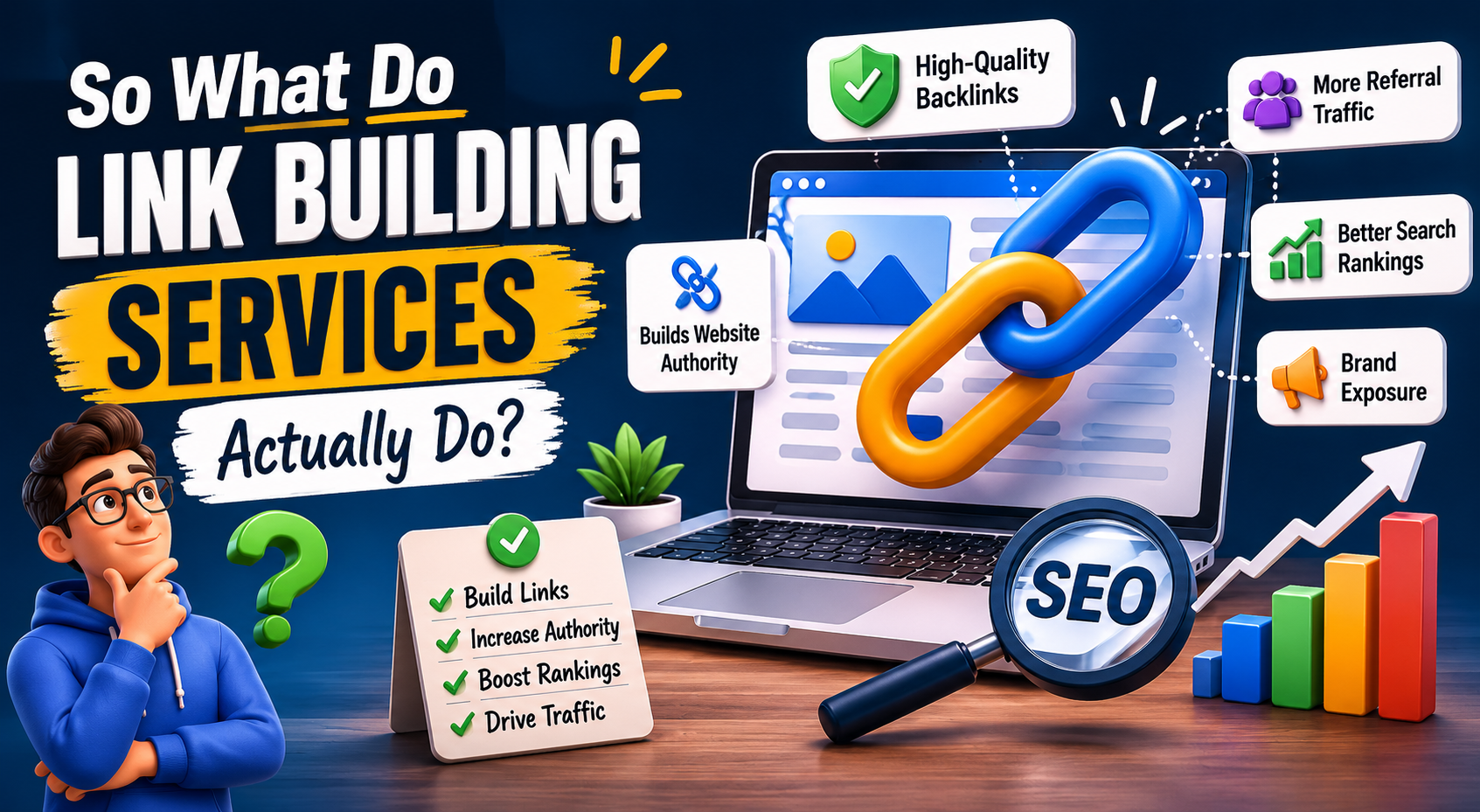
Short answer: they do the work you don’t have time for.
The longer answer — good SEO link building services handle everything from finding sites worth getting links from, to writing the content, to getting it published. You approve the placement, they handle the rest.
The problem is “link building service” is a term that covers everything from legitimate, white-hat outreach campaigns to absolute link farms that’ll get your site slapped. The label means nothing. What matters is what’s underneath it.
A provider worth working with will tell you upfront:
- Which sites they’re targeting and why
- What metrics they use to vet publishers (traffic, not just DA scores)
- Whether you can review content before it goes live
- What happens if a link drops
If any of those questions get a vague answer, keep shopping. There are enough link building service providers out there that you don’t need to gamble on one that won’t give you a straight answer.
Why Guest Posting Keeps Winning
There are a dozen ways to build links. Broken link building, HARO/source outreach, digital PR, niche edits, resource page links — all of them have their place.
But guest posting has been the backbone of white-hat link building for over a decade, and there’s a simple reason it’s stuck around: it works on multiple levels at once.
You get the link, obviously. But you also get your brand in front of an audience that’s already interested in your space. A well-written guest post on a respected industry blog can send you referral traffic for years. I’ve seen single placements drive hundreds of qualified visitors long after the SEO value was fully baked in.
The anchor text is another thing. With a guest post, you (usually) control exactly how you’re linked. That’s huge. A natural-looking anchor text profile is something you have to actively manage — you can’t just hope sites link to you the way you want.
The one honest downside is time. Real guest blogging outreach service work is slow. Finding a site that’s worth pitching, actually getting a response, negotiating, writing something good enough to get accepted — that’s easily a full day’s work per link, sometimes more. For people running businesses, that’s not realistic. That’s exactly why the guest posting service provider market exists.
Breaking Down Link Building Packages
Packages confuse people because the pricing feels arbitrary until you understand what you’re actually paying for.
Here’s the basic logic: you’re paying for the authority of the site, the relevance of the niche, and the quality of the content. Those three things together determine whether a link actually does anything for you.
Domain Rating (DR) / Domain Authority (DA) These are third-party metrics from Ahrefs and Moz. They’re imperfect but directionally useful. A DR 60 site has, in general, a stronger link profile than a DR 25 site. Most link building packages will advertise a minimum DR. Pay attention to it — but don’t treat it as the only number that matters.
Real Organic Traffic This one gets overlooked constantly. A site can have decent DR if it was once authoritative, even if it now gets zero traffic. Google likely sees the difference. Always push for placements on sites with verified, active organic traffic. A DR 40 site getting 5,000 monthly visitors from search is worth more than a DR 55 ghost town.
Niche Fit A cooking site linking to your cybersecurity company is basically a wasted link. Relevance signals context. The closer the site’s topic is to yours, the more Google understands why that endorsement makes sense.
What the Content Actually Looks Like Thin, 400-word filler that exists purely to host a link is increasingly useless. The best placements involve real articles — something a reader would actually find useful. That’s what editorial quality means in practice.
The Guest Post Marketplace Model Changed Everything
For years, getting guest post placements meant either doing manual outreach yourself or hiring an agency to do it for you. Both options have obvious drawbacks — time for the first, cost for the second.
The guest post marketplace model fixed a lot of that.
A guest posting marketplace is essentially a platform where publishers list their sites and buyers browse, filter, and purchase placements directly. No cold email campaigns. No chasing unresponsive contacts. No wondering whether a site is even worth your time before you’ve already spent three hours on it.
The best guest blog post marketplace platforms give you filters for DR, niche, traffic, pricing — and you can see exactly what you’re getting before any money changes hands. That transparency alone is a massive improvement over traditional outreach, where you often don’t know the full picture until after the deal is done.
For agencies, a guest blogging marketplace is a multiplier. Instead of building out an entire outreach team to fulfill client link orders, you tap into an existing inventory of vetted publisher sites. Faster delivery, lower overhead, predictable quality.
GuestPostSale.com operates exactly this way — a dedicated link building marketplace where publishers and buyers connect without the usual friction. Whether you’re buying a handful of links for a new site or managing a large-scale SEO campaign, the model scales in a way that manual outreach just doesn’t.
“Buy Quality Backlinks” — Let’s Talk Honestly About This
The phrase makes people uncomfortable. I get it.
Google has been pretty vocal about paid links violating their guidelines. But here’s the nuance that most of those conversations skip: there’s a massive difference between buying a spot in a link farm and paying for editorial placement in a genuine publication.
When you go through a reputable guest posting agency or a properly managed marketplace, what you’re actually paying for is the outreach, the content, and the publisher relationship. The link comes as a result of an article that a real editor approved and published on a real site with real readers. That’s not a scheme. That’s a content marketing transaction.
The stuff Google actually hammers is the obvious manipulation — hundreds of links appearing overnight from sites that have nothing to do with your niche, all with the same exact-match anchor text, going to the same page. That’s the pattern their systems are built to catch.
Building a natural-looking profile through buy and sell guest post arrangements on a quality platform? That’s a different animal entirely. Do it right, and the profile you build is indistinguishable from one built entirely through organic outreach — because in terms of what the links actually represent, it is.
What Separates the Best Guest Post Marketplace From the Rest
Not all platforms are equal. Here’s what I’d actually look for:
Updated Metrics Sites change. A publisher that had strong traffic two years ago might be a shell today. The best guest post marketplace platforms refresh their data regularly so you’re not buying based on stale numbers.
Publisher Vetting How did those sites get listed? Did someone actually review them, or did the platform just let anyone sign up? There’s a real difference between a curated marketplace and an open directory with a fancy interface.
Niche Depth If every site on the platform is a generic “digital marketing” or “health and wellness” blog, the relevance targeting gets thin fast. A good marketplace has genuine variety — finance, legal, home services, e-commerce, SaaS, local business, etc.
Honest Policies What happens when a link gets removed? What’s the revision process if the content misses the mark? These questions matter more than they seem upfront.
Actual Support This sounds basic, but you’d be surprised. Agencies and buyers placing regular orders need responsive communication. A marketplace that goes quiet when something goes wrong isn’t worth the savings.
Guest Post Packages: A Quick Reference
Most guest post packages follow a tiered structure. Here’s a practical breakdown:
| Package Tier | DR Range | Word Count | Best For |
| Starter | DR 20–35 | 500–700 words | New sites, early-stage builds |
| Standard | DR 35–55 | 700–1,000 words | Growing sites, mid-competition niches |
| Premium | DR 55–70+ | 1,000–1,500 words | Established sites, tighter verticals |
| Authority | DR 70+ | 1,500+ words | Competitive niches, enterprise campaigns |
Most campaigns benefit from mixing Standard and Premium. Going all-in on cheap starter links looks unnatural fast. Going all-in on Authority placements burns budget quickly without necessarily delivering proportional results at first.
Building a Real SEO Link Building Strategy (Not Just Buying Random Links)
Start with a profile audit. What do you currently have? How many referring domains? What’s the anchor text distribution? Are there any obvious toxic links dragging you down? You need this picture before you build anything.
Buying links without a strategy is like buying gym equipment and leaving it in the garage. The tool doesn’t do anything if you don’t have a plan around it.
Look at what’s actually ranking. For each keyword cluster you’re targeting, check the backlink profiles of the top three pages. That’s your real benchmark — not some arbitrary number of links per month.
Be ruthless about relevance. One link from a directly relevant site in your niche is worth more than five generic placements. Especially in tighter verticals, relevance carries serious weight.
Watch your anchor text. Over-optimized anchor text is one of the fastest ways to trigger a manual review. Keep a mix: branded, partial match, generic, URL-only. Guest posting services for SEO should be helping you manage this, not just dropping exact-match anchors on every placement.
Give it time, then adjust. Links typically take 60–90 days to show full impact in rankings. Don’t panic and overload a page with links in month one. Build consistently, measure at the 90-day mark, adjust from there.
Who Actually Needs Professional Guest Posting Services?
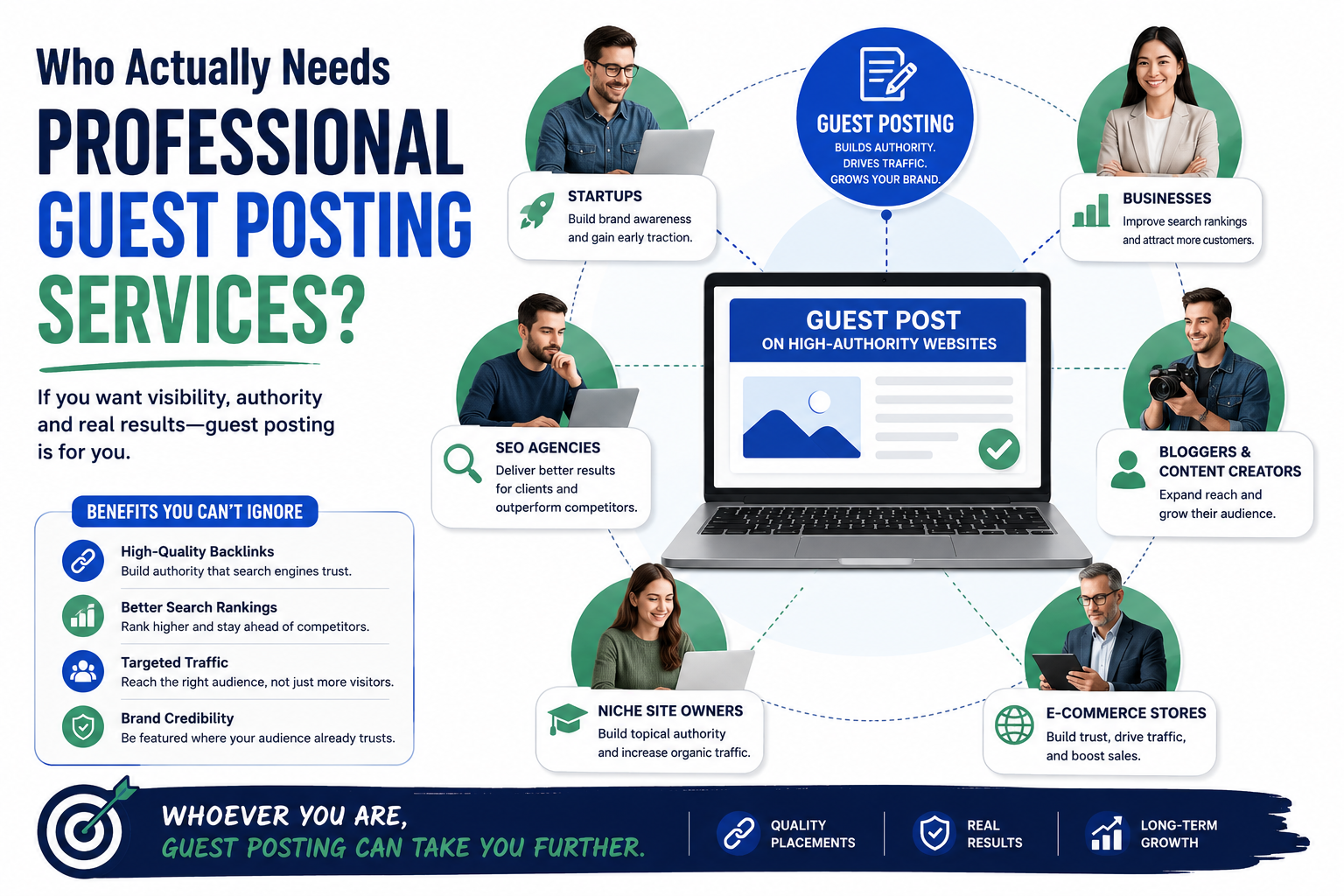
More people than you’d think.
The obvious answer is SEO agencies — they need to fulfill client orders at scale without exploding their internal headcount. A managed guest posting services setup handles that cleanly.
But beyond agencies, professional guest posting services make sense for:
Solo founders who understand that SEO is important but genuinely cannot dedicate 15+ hours a week to outreach. The business has to run.
E-commerce brands trying to rank competitive category pages. Those pages need serious link authority behind them, and organic editorial coverage is the cleanest way to build it.
B2B companies where one ranked keyword translates to six-figure pipeline. At that ROI math, paying for quality placements is trivially justified.
Content creators and bloggers who’ve been building good content for years and keep getting outranked by sites with thinner material but stronger link profiles. That frustration has a direct solution.
Why GuestPostSale.com
There are a lot of platforms in this space now. The reason GuestPostSale.com is worth looking at seriously comes down to two things: curation and simplicity.
The site inventory is actually vetted. You’re not sorting through junk to find usable placements. The publisher sites listed are real sites with real traffic, and the metrics reflect current performance — not historical peaks.
The ordering process is straightforward. Browse by niche and domain metrics, pick your placements, submit your order. No chasing account managers, no wondering where things stand. For agencies with regular volume, that predictability matters enormously.
It works on both sides of the transaction, too. If you own a site with solid authority and you want to monetize it through guest post placements, the platform gives you a clean way to do that without managing a constant stream of cold outreach emails yourself.
Whether you’re a solo operator placing a few links a month or an agency running dozens of campaigns simultaneously, the platform is built to scale with you.
Final Word
Nobody ranks on page one by accident in a competitive niche. Behind almost every strong-ranking site is a deliberate, consistent link building effort — usually built through a combination of guest posting, editorial placements, and smart use of tools like a link building marketplace.
The shortcuts don’t work anymore. The link farms, the PBNs, the bulk directory submissions — those are dead ends that waste time and money and can actively hurt you.
What works is simpler: real content, published on real sites, earning real links. Do that consistently over six to twelve months and the rankings follow.
GuestPostSale.com exists to make that process faster and less painful. Check out what’s available, see the publisher inventory, and start building something that actually lasts.
Start building at GuestPostSale.com
Frequently Asked Questions (FAQs)
Q1. What are link building services and do I actually need them?
Link building services are agencies, platforms, or tools that help you acquire backlinks to your website from other sites. Whether you need them depends on your goals. If you’re targeting competitive keywords and want to rank on Google’s first page, then yes — you almost certainly need a deliberate link building strategy. Trying to rank in a competitive niche without links is like showing up to a race without shoes. You can try, but the result is predictable.
Q2. What is a guest post marketplace and how does it work?
A guest post marketplace is a platform that connects website owners (publishers) who are open to hosting guest content with buyers (businesses, SEO professionals) who want backlinks. Instead of manually doing cold outreach — which takes forever — you log into the marketplace, filter sites by niche, DR, traffic, or price, and place an order directly. GuestPostSale.com works exactly this way, making the whole process faster and far more transparent than traditional outreach.
Q3. Is buying guest posts against Google’s guidelines?
Technically, Google’s guidelines say links should be “earned naturally.” But the reality is more nuanced. Google’s enforcement targets obvious manipulation — bulk links from private blog networks, link farms, and spammy directories. Editorial placements on real, active websites where genuine content is published are a fundamentally different thing. The key is placement quality: real sites, real traffic, real editorial standards.
Q4. How long does it take to see results from link building?
Most people see meaningful movement within 3 to 6 months of consistent link building, assuming the on-page SEO is already solid. New links typically take 4 to 8 weeks to get fully crawled and reflected in rankings. Don’t judge a campaign at the 30-day mark. The sites that compound their link building month after month are the ones that dominate their niches — it’s not a one-time fix, it’s an ongoing investment.
Q5. What should I avoid when choosing a link building service provider?
A few red flags worth knowing: providers who won’t show you placement sites before purchase, packages that promise unrealistically high DR at suspiciously low prices, bulk link offers with no mention of niche relevance, and services that use the same pool of sites for every client. Also be cautious of providers who can’t show you real examples of past placements or who go quiet after payment. The best link building service providers are transparent, responsive, and focused on quality over volume.