
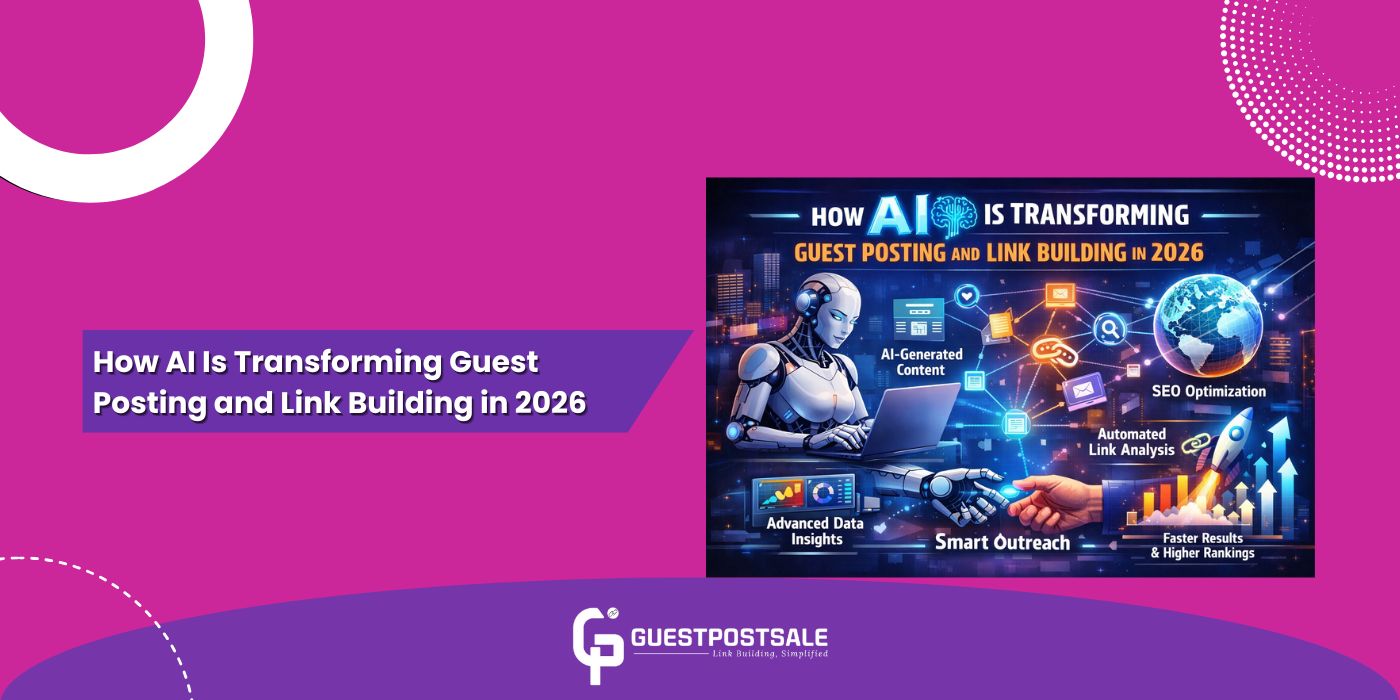
A few years ago, SEO felt straightforward.
Write content. Build links. Watch rankings move.
But in 2026, the game has shifted in ways most people did not see coming.
AI has entered nearly every part of the digital marketing process. Research, writing, outreach, analysis, reporting. It is no longer a future trend. It is happening right now, on real campaigns, for real businesses.
And nowhere is this shift more visible than in guest posting and link building.
The way agencies find sites, pitch editors, write content, place links, and measure results has changed dramatically. Some of that change is exciting. Some of it requires caution.
This blog breaks it all down.
The Old Way Was Slow. The New Way Is Fast. But Speed Is Not the Point.
Before AI, building quality backlinks took a lot of manual effort.
You would search for websites in your niche. Check their metrics one by one. Draft personalised pitches. Wait for responses. Follow up. Write the content. Submit it. Then wait again.
It was time-consuming. It was inconsistent. And it was hard to scale without sacrificing quality.
AI has changed the speed of almost every step in that process.
But here is the thing most people get wrong.
Speed is not the goal. Quality is.
The best use of AI in guest posting and link building is not to do more things faster. It is to do the right things smarter. That distinction matters enormously when you are investing in guest posting services or choosing between link building service providers.
AI Is Transforming Site Research and Opportunity Discovery
Finding the right websites to pitch used to eat hours of a strategist’s week.
You needed sites that were relevant to your niche, had genuine traffic, accepted guest content, and had not been overused by other SEO sellers. Manually filtering thousands of domains for those criteria was painful.
AI tools now do that filtering in minutes.
They analyse domain authority, organic traffic signals, niche relevance, publishing frequency, and link patterns. They flag sites that look like link farms. They surface opportunities that manual searching would miss.
For any serious link building marketplace or agency operating at scale, this kind of AI-powered research is now a baseline expectation. It removes a lot of guesswork from the site selection process and helps buyers invest in placements that are genuinely worth the spend.
That said, smart buyers still look beyond the numbers. AI can identify a site that ticks the metric boxes. A human still needs to read the site and decide whether it passes a basic editorial quality check.
Outreach Has Gotten Smarter. But Generic Pitches Still Fail.
Guest post outreach used to be a volume game.
Send a hundred emails. Hope five editors reply. Close two placements. Repeat.
That approach still exists. But it is becoming less effective as editors get smarter about filtering out generic pitches.
AI-assisted outreach is different. It analyses the tone, topics, and publishing style of each target site before writing the pitch. It personalises subject lines. It references recent articles on the site. It adjusts the message to match what each editor is likely to care about.
A good guest blogging outreach service in 2026 is built on this kind of intelligent personalisation. It is not about sending more pitches. It is about sending better ones to the right people at the right time.
Response rates improve. Relationships are built faster. And the sites that say yes are more likely to be genuinely relevant.
Content Creation: AI Assists. Humans Decide.
This is the area where most of the debate happens.
AI writing tools have improved significantly. They can produce structured, readable first drafts quickly. They can research a topic, suggest headings, match a target site’s tone, and weave in keywords naturally.
That makes them genuinely useful for speeding up content production.
But they are not a replacement for editorial judgement.
The websites that accept guest posts are run by real editors. Those editors can spot content that was generated carelessly. They reject articles that feel hollow, over-formatted, or stuffed with keywords. And more sites are now explicitly rejecting AI-only content in their submission guidelines.
The best professional guest posting services handle this correctly. They use AI to speed up the research and drafting process. They then use experienced human writers and editors to shape the final piece. The result is content that is faster to produce and still high enough in quality to get accepted and genuinely read.
Content that does not get accepted does not build links. Content that does not get read does not build authority.
That is the standard worth holding.
Link Placement Has Become More Precise
Getting a backlink placed is only one part of the job.
Where the link sits in the article matters. What anchor text surrounds it matters. How naturally it flows into the content matters. A forced or over-optimised link can actually hurt the page it is supposed to help.
AI tools now analyse these factors before a single link is placed. They look at the surrounding content, the existing anchor text distribution on the page, the backlink profile of the target domain, and the relevance of the context.
This level of precision was not possible at scale before AI. It required a senior SEO analyst spending significant time on each placement.
Now it is part of how any serious SEO link building services provider approaches campaign execution. The result is link profiles that look natural, relevant, and sustainable over time rather than profiles that trigger algorithmic caution.
Packages and Campaigns Are Being Planned with Better Data
One of the biggest improvements AI has brought to link building is better planning.
In the past, link building packages were often built on rough assumptions. A fixed number of links per month. A spread across different metrics. A general plan that did not account much for the specific needs of each campaign.
Now AI tools can analyse a client’s existing backlink profile, identify gaps in niche coverage, spot anchor text imbalances, and map competitor link patterns. That data shapes a much smarter campaign strategy.
Similarly, guest post packages are no longer just a number of articles delivered to a number of sites. The best providers now build packages around specific keyword targets, content angles, and placement strategies that are informed by real data.
This changes the conversation from “how many links do I get” to “what kind of authority am I actually building.”
That is a much better question.
Measurement and Reporting Have Finally Caught Up
For years, link building suffered from a reporting problem.
You could see that links was placed. You could check rankings after a few months. But connecting specific placements to specific results was hard. You were mostly working on faith that the links were doing something useful.
AI-powered analytics tools have changed this.
They can now track the authority contribution of individual backlinks over time. They can correlate specific placements with ranking movements for targeted keywords. They can flag links that have become inactive, lost authority, or been de-indexed.
For anyone running link building services for SEO at a serious level, this reporting capability matters enormously. Clients can now see real data instead of just a list of URLs.
And agencies can use that data to improve future campaigns instead of repeating what might have been working and what might not.
What AI Cannot Replace
It is easy to read all of this and assume that human involvement in link building is shrinking.
The opposite is actually true.
AI handles the heavy processing work. It manages data at a scale that no human team could match. But it does not replace the judgement calls that make link building actually work.
A machine can identify that a site has good metrics. A human decides whether the site actually feels trustworthy.
A machine can write a first draft. A human decides whether the article is genuinely useful.
A machine can suggest anchor text. A human decides whether it sounds natural in context.
A machine can track reporting data. A human decides what it means for the next campaign.
The best guest posting services for SEO in 2026 have figured out how to combine both. They use AI to work faster. They use human expertise to maintain quality. Neither one alone is enough.
What to Look for in a Provider Right Now
If you are evaluating a guest posting service provider or a link building partner in 2026, the standards should be higher than they were before.
Here is what actually matters:
- Transparency about site selection. You should know how sites are chosen and be able to review them before committing.
- Clear content standards. Ask whether articles go through human editorial review before submission.
- Honest reporting. Real data about placements, traffic signals, and ranking impact is a sign of a serious provider.
- No unrealistic promises. Any provider guaranteeing instant rankings from a handful of links is not being straight with you.
- Relevance over raw metrics. A good provider will talk about niche fit before authority scores.
The Bigger Picture
AI has not made guest posting or link building easier in the lazy sense.
It has made the bar higher.
Because AI can now help any team research faster, write faster, and reach out faster, the sites that accept guest posts are more selective. The search algorithms that evaluate backlinks are more sophisticated. And the buyers investing in link building are more informed.
That means the providers who will win in this environment are not the ones moving the fastest.
They are the ones maintaining the highest standards.
Final Thoughts
In 2026, AI is a tool. Not a shortcut.
The agencies and providers who understand that are delivering better campaigns, building cleaner backlink profiles, and earning more trust from their clients.
The ones treating AI as a bulk content machine or a way to flood inboxes with generic pitches are producing the same low-quality results, just at higher volume.
If you are investing in link building packages, working with a link building marketplace, or choosing a new guest posting service provider this year, use the same filter you would apply to any important business decision.
Ask the right questions. Look for honesty. Prioritise quality over speed.
Because the goal was never just to build links.
The goal was always to build authority.
FAQ Section
What are guest posting services?
Guest posting services help businesses place content on relevant third-party websites to earn quality backlinks. A good service handles site research, outreach, content creation, and placement as a managed process.
How is AI changing link building services for SEO?
AI is improving the speed and accuracy of site research, outreach personalisation, content drafting, link placement analysis, and campaign reporting. It makes every step more data-driven. But it works best when paired with experienced human oversight.
Are AI-written guest posts accepted by editors?
Several editors are now filtering AI-only content and disapproving it. The most secure one is AI-assisted writing and human editing and quality check prior to submission. The combination of that provides content meeting editorial standards.
What do I need to consider in guest post packages?
Find packages with specifications on niche relevance, site quality standards, content review processes, anchor text strategy, and transparent reporting. Packages that consider volume or raw authority measures alone should be avoided.
Which is the right link building service provider?
Select providers that are open about their site selection process and truthful about realistic results, and concentrate on relevance, not on vanity metrics. Inquire about the ways in which they utilize AI and the involvement of human review.
Is link building marketplace safe to use?
It is platform-based. Secure markets include comprehensive site descriptions, editorial reviews, clear pricing and realistic expectations. When a marketplace only drives on high metrics and conceals the site information, it is a red flag.