
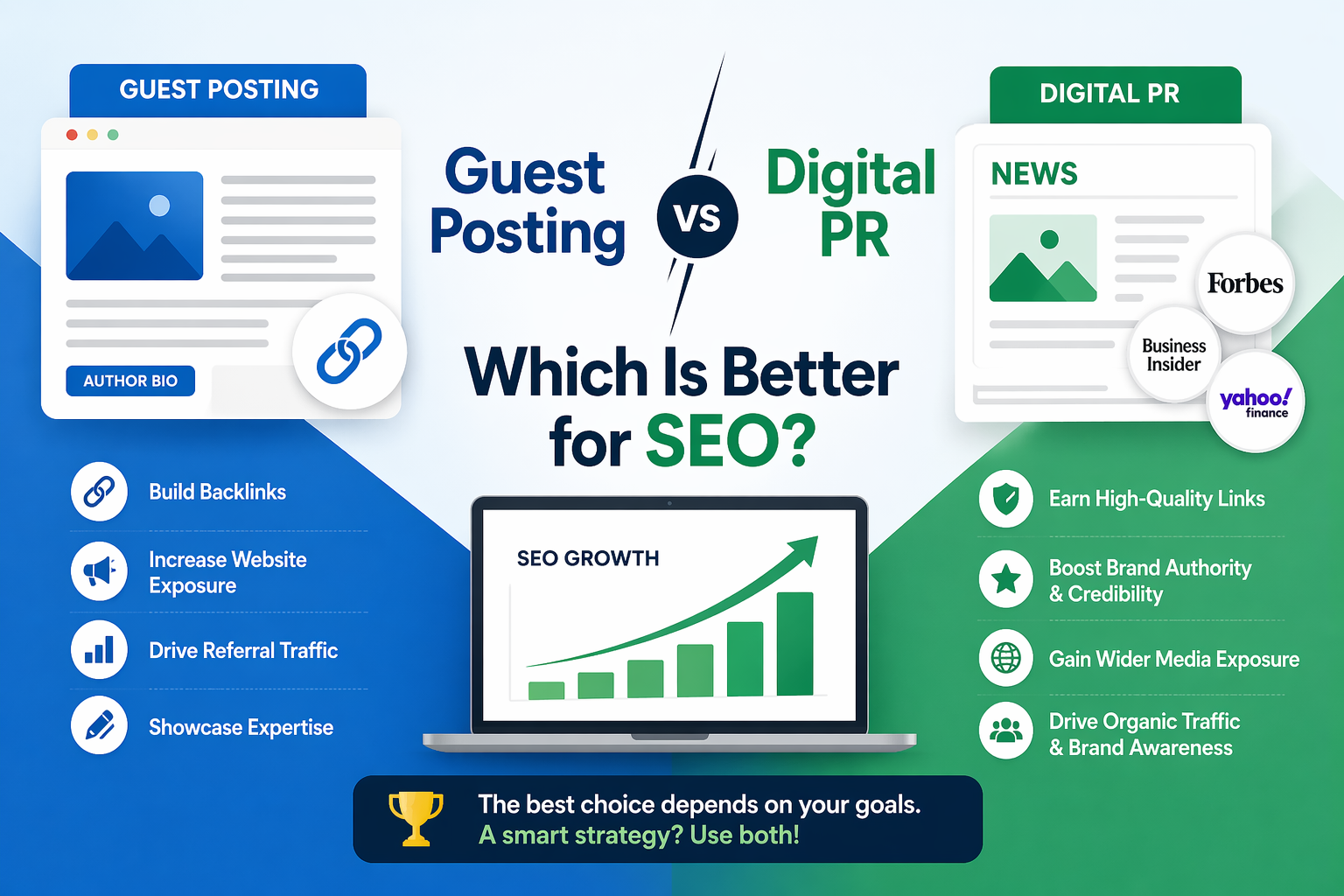
For marketers, business owners, and SEO professionals trying to decide where to invest their link building budget guest posting campaigns or digital PR efforts this guide breaks down the real differences, the actual costs, and which method wins for your specific goals.
You have heard both sides of the argument. Some SEO experts swear that digital PR is the only future-proof way to build links. Others insist that guest posting still delivers the best return on every dollar spent. The truth is more useful than either extreme and the right answer depends entirely on your budget, your niche, and how fast you need results.
Both methods build backlinks. Both methods can move your rankings. However, they operate differently, have very dissimilar prices, and bring about various types of value to your site. A 2024 Authority Hacker survey has revealed that guest posting is the most popular technique of link building with 64.9 percent of SEO practitioners using it, with only 28.4 percent using digital PR, but when successful, it results in links on sites with domain authorities of 80 or higher.
The guide is addressed to every person who has to decide practically between these two approaches. It discusses what guest posting and digital PR are, what are their cost-benefits, which one will provide better outcomes, the most frequent mistakes to avoid with each of them, and when to apply both of them. In case you need dependable Guest Posting Services or a reliable Press Release Distribution Service, this guide will assist you in comprehending what you are buying in the first place before making a commitment.
What Is Guest Posting and How Does It Work for SEO?
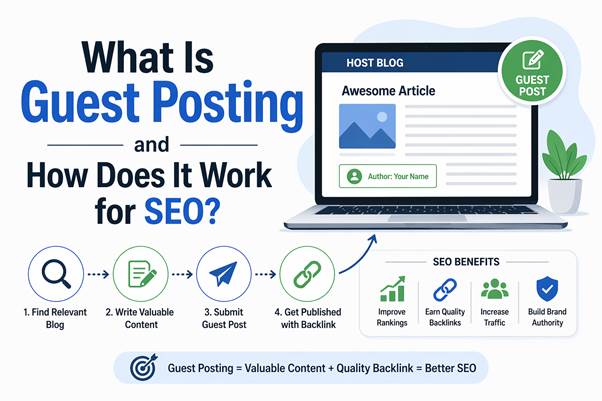
Guest posting is the technique of writing an article on a different site within your sector and getting a backlink to your own site within the article. The publisher receives no-charge good content. You have a contextual backlink with a relevant site that sends Google signals that your page should rank higher.
It is simple to do. You identify sites that are in your niche and allow external writers. You suggest a subject which suits their content style. You write the article with an in-body natural backlink. The editor reads it, publishes it and your link becomes live. A single link will be able to generate years of referral traffic, and impart SEO value to your target page as long as it remains online.
Most businesses today skip the manual outreach and use Professional Guest Posting Services instead. These services do the publisher research, the writing, the negotiation and the placement to allow you just to select your target sites and authorize the content. A quality Guest Posting Agency will provide you with the domain authority of the publisher, monthly traffic and niche before you pay. Such transparency is what can distinguish trustworthy Guest Posting Services to promote your business or cheap bulk link sellers.
Pricing varies. On a small niche blog, a guest post will cost between $80 and 150. Placing on a high-authority industry publication may be as much as $400 to $1,000 or higher. Most Guest Post Packages are packages of 5,10 or 20 placements that are charged a reduced per-link fee. This predictable cost model is among the primary reasons why guests posting dominates link building budgets you can be assured of what you are getting before you spend a dime.
What Is Digital PR and How Is It Different?
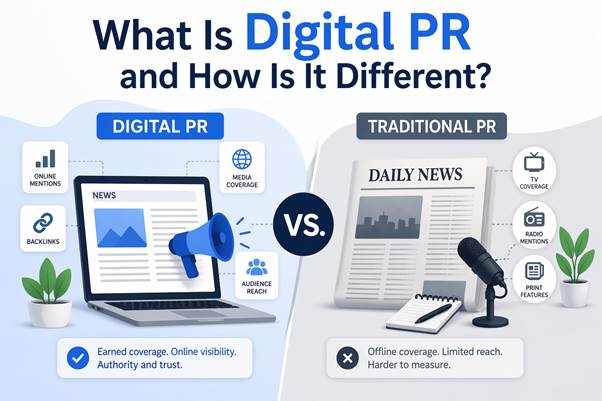
Digital PR refers to the act of establishing newsworthy stories, research or data, and sharing them with journalists and editors of online publications. When a journalist takes up the story, he/she writes on it and refers to the source of originality which is your webpage.
It is not only about a backlink. It is coverage. An effective digital PR campaign can get you featured in Forbes, BBC, HuffPost, or other publications in the industry. Such links have colossal power since the sites that post the links are reputable news portals that have millions of visitors every month. A single mention on a high-quality publication can outperform 50 mediocre guest posts in terms of SEO value.
But digital PR is more difficult. Much harder. You must have a truly intriguing story original research, survey data, a controversial viewpoint, or a timely response to industry news. You require a list of reporters that report your space. You have to pitch at the correct time at the correct angle. And there too the majority of pitches are neglected. The industry statistics indicate that the average response rate of digital PR is about 3-5 percent.
A Press Release Service or Press Release Distribution Service helps bridge this gap. These services write your announcement in journalist-friendly format and distribute it to a network of media outlets, syndication platforms, and online news sites. Press Release Packages typically include writing, distribution to 200 to 500 outlets, and a report showing where the release was picked up. Costs range from $200 for basic distribution to $2,000+ for premium campaigns with targeted journalist outreach.
The key difference from guest posting: with press releases and digital PR, you do not control where the links land. You launch the campaign and hope the right publications notice. Sometimes you get fifty pickups. Sometimes you get two. That unpredictability is the main trade-off.
Side-by-Side Comparison: Guest Posting vs Digital PR
Here is how the two methods stack up across the factors that matter most.
| Factor | Guest Posting | Digital PR |
| Cost per link | $80 to $1,000 | $500 to $5,000+ per campaign |
| Predictability | High — you pick the site | Low — depends on pickup |
| Turnaround time | 7 to 30 days | 2 to 8 weeks |
| Link authority | Medium to high | High to very high |
| Niche relevance | Very high — you target the site | Mixed — depends on who picks up |
| Content control | Full — you write the article | Partial — journalist rewrites story |
| Scalability | High — order more anytime | Low — each campaign is custom |
| Skill required | Low with a service | High — needs PR expertise |
| Best for | Steady link velocity | Big authority wins |
Guest posting wins on predictability and cost control. You know the site, the traffic, the domain authority, and the anchor text before you pay. Digital PR wins on ceiling when a campaign lands in a major publication, the link value is hard to match through guest posts alone.
When Guest Posting Is the Better Choice
Guest posting is the right call in most real-world scenarios for small and mid-sized businesses. Here are the five clearest signals that guest posting should be your primary link building method.
You Need Consistent Monthly Link Velocity
Google rewards steady, predictable backlink growth. A site that earns 5 to 10 new links per month consistently outranks a site that gets 50 links in one month and zero the next. Guest posting is built for exactly this kind of steady pace. With a reliable Guest Post Package, you can plan 8 to 15 placements every month and know they will happen.
Your Budget Is Under $3,000 Per Month
Digital PR campaigns often start at $3,000 to $5,000 and can run much higher with no guaranteed results. For that same budget, a Guest Posting Service can deliver 10 to 20 confirmed placements on relevant sites with known metrics. If you are a small business or a startup, guest posting almost always gives you more measurable output per dollar.
You Are in a Non-Newsworthy Niche
Not every industry generates media interest. Plumbing services, local dental clinics, B2B accounting software, and niche ecommerce stores rarely produce stories that journalists care about. If your industry does not naturally fit into news cycles, digital PR will struggle. Guest posting works in every niche because niche blogs are always looking for quality content.
You Want Full Control Over Anchor Text and Target Page
With guest posting, you write the article. You choose the anchor text. You pick the exact target URL. This control matters for SEO campaigns where you are trying to rank specific money pages for specific keywords. Digital PR usually gives you a branded link to your homepage — valuable, but less useful when you need to boost a particular product page.
You Are Building a New Site from Scratch
New websites need foundational links before they can rank for anything. Digital PR rarely works for unknown brands because journalists prefer quoting established sources. Guest posting does not care about your brand reputation publishers just want quality content. A steady stream of guest posts on relevant Guest Blogging Websites is the fastest way to build initial authority.
When Digital PR Is the Better Choice
Digital PR is not for everyone, but when it fits, nothing else comes close to the authority and exposure it can deliver. Here are the scenarios where press releases and digital PR should take priority.
You Have Original Data, Research, or a Genuine Story
Journalists need hooks. If you have conducted original research, collected unique survey data, or have access to exclusive industry insights, digital PR can turn that story into dozens of high-authority links. A single data study, if well-distributed, can earn links from sites with DA 80 or above the kind of authority that guest posting rarely reaches.
You Are an Established Brand Ready to Scale Authority
Once your site has a solid foundation of 50 to 100 quality backlinks from guest posts, digital PR becomes a multiplier. Brands with existing authority get more journalist responses because editors recognize the name. At that stage, shifting 30 to 40 percent of your link budget into a Press Release Service can unlock coverage that pushes you past the competition.
You Are in a Newsworthy Industry
Finance, health, technology, real estate, and consumer products all generate constant media coverage. If you operate in an industry where journalists publish multiple stories per day, your chances of pickup go up dramatically. Press Release Packages work best when your news fits a category journalists already cover.
You Need Brand Visibility, Not Just Backlinks
Guest posts sit on blogs and pass SEO value quietly. Digital PR puts your brand name in front of thousands of readers on major publications. The traffic, the mentions, and the brand recall you get from one Forbes feature can be worth more than 30 guest posts even if the direct SEO value is similar.
You Have a Product Launch, Funding Round, or Major Announcement
Some moments demand a press release. A new product. A funding round. A major partnership. An award. These are natural fits for Press Release Distribution Service packages because they give journalists a clear reason to cover you. Outside of these moments, cold PR pitches are much harder.
Common Mistakes That Waste Your Budget
Both methods have predictable pitfalls. Avoid these and you will get far more value from every dollar you spend.
Mistake 1: Choosing Guest Post Sites Only by Domain Authority
A DA 60 general blog with no niche relevance passes less ranking value than a DA 35 site that covers your exact industry. Always filter Guest Blogging Websites by topic first, then by authority. Relevance beats raw DA every single time.
Mistake 2: Publishing Press Releases with No Real News
Press releases that announce nothing “Company launches new website,” “CEO shares thoughts on industry” get zero pickups and zero links. If your press release does not contain news, data, or a genuine hook, save the money. A Press Release Service can only distribute what you give them.
Mistake 3: Using Identical Anchor Text Across Every Link
Whether you are doing guest posts or press releases, repeating the same exact-match keyword as anchor text on 20 links is a red flag to Google. Mix branded anchors, partial-match phrases, and generic text like “read more” to keep your link profile looking natural.
Mistake 4: Buying Cheap Bulk Guest Posts from Unknown Vendors
The market is full of $20 guest post offers. They almost always place your link on a private blog network or a fake site with no real traffic. A reputable Guest Posting Agency charges $100 to $500 per placement because real publishers charge real money to accept content. Cheap links are expensive in the long run they waste budget and can trigger Google penalties.
Mistake 5: Treating Either Method as a One-Off Project
One press release will not transform your rankings. Five guest posts will not either. Both methods work through compounding consistent monthly activity builds the authority that moves the needle. Plan at least six months of sustained effort before judging results.
How to Pick the Right Service Provider
Whether you choose guest posting, digital PR, or both, the provider you pick makes or breaks your results.
For guest posting, look for a Guest Post Website or platform that shows you the publisher’s domain authority, monthly organic traffic, niche category, and content samples before you place an order. Avoid services that send you a “secret list” only after you pay. Transparency is the single strongest signal of a legitimate Guest Posting Service for SEO.
For digital PR, look for a Press Release Distribution Service that shares a real list of outlets, offers journalist outreach beyond basic syndication, and provides a coverage report after the campaign. Good Press Release Packages show you exactly where your release will go and roughly how many pickups to expect.
Check reviews on third-party platforms. Ask for sample reports. Start with a small test order before committing to a long contract. Any provider worth working with will gladly prove their value on a small project before asking for a larger commitment.
The Hybrid Approach Most Brands Actually Use
The smartest SEO teams do not pick one method over the other. They run both in parallel, with different goals.
Guest posting handles the monthly foundation steady link velocity, niche relevance, direct anchor text control, predictable cost. Most brands allocate 60 to 70 percent of their link budget here using Professional Guest Posting Services that deliver 8 to 15 links per month.
Digital PR handles the breakthrough moments major authority wins, brand visibility, tier-one publications. Brands run one or two digital PR campaigns per quarter, timed around product launches, original research, or seasonal hooks. This 30 to 40 percent of budget produces fewer links but higher ceiling links.
The combination works because the two methods cover each other’s weaknesses. Guest posting gives you the predictable pipeline Google rewards. Digital PR gives you the high-authority wins that guest posting alone rarely produces. Together, they build a backlink profile that looks natural, grows steadily, and includes the occasional big win that pushes competitive keywords to page one.
Conclusion
Guest posting and digital PR are both legitimate, powerful ways to build the backlinks that Google rewards. Neither is universally better the right choice depends on your budget, your niche, your content assets, and how fast you need results. For most small and mid-sized businesses, guest posting delivers more predictable value per dollar and should form the backbone of any link building strategy. Digital PR becomes essential once your site has foundational authority and you have genuine stories worth telling. The three points that matter most: consistency beats intensity in both methods, quality always outweighs quantity, and the best campaigns combine both approaches with different budget splits across the year. Whether you are comparing Guest Post Packages for monthly placements or evaluating a Press Release Service for a major announcement, the key is starting with clear goals and picking a provider who shows you exactly what you are paying for. Measured, steady link building — through whichever method fits your situation is still the single most reliable way to move rankings in 2026.
Frequently Asked Questions
Q1: Is guest posting still effective for SEO in 2026?
Yes. Guest posting remains one of the most used and most effective links building methods, delivering niche-relevant backlinks with full control over target page and anchor text.
Q2: Do press releases actually help SEO?
Press releases help when they contain real news and get picked up by legitimate publications. A Press Release Distribution Service with journalist outreach produces better SEO results than basic syndication alone.
Q3: How much should I spend on guest posting per month?
Most small to mid-sized businesses spend between $800 and $3,000 per month on Guest Posting Services, which covers 8 to 20 placements on relevant sites.
Q4: Which is cheaper, guest posting or digital PR?
Guest posting is almost always cheaper per link and offers predictable pricing through Guest Post Packages. Digital PR has higher campaign costs but higher ceiling value when a campaign hits.
Q5: Can I do guest posting and digital PR at the same time?
Yes, and most successful brands do. Guest posting builds monthly link velocity while digital PR targets high-authority wins during key moments like product launches or research releases.