
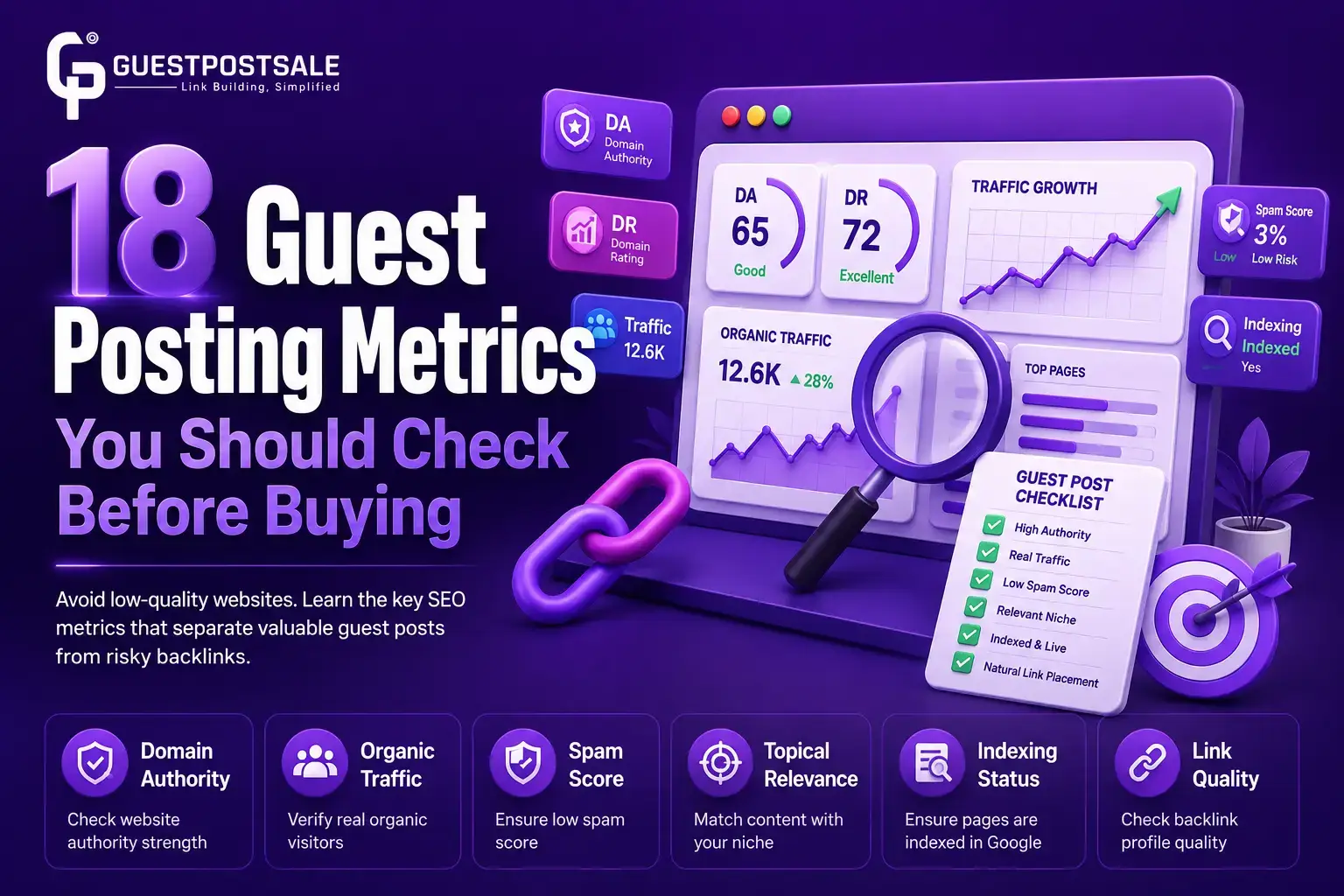
Before you pay for a single guest post, check these 18 metrics: authority scores, real organic traffic, referring domain growth patterns, spam score, topical relevance, anchor profile, and link disclosure status, among others. Skip any one of them and you’re buying a coin flip, not a backlink strategy.
We say this having run the numbers ourselves. When we audited 40 guest post placements purchased by a mid-size SaaS client last quarter, 11 of them came from sites with organic traffic that had collapsed by more than 60% in the six months prior a fact the sellers never volunteered, and one that a five-minute Ahrefs check would have caught. This post exists because that kind of due diligence shouldn’t be optional, and because most “how to buy guest posts” content online still treats Domain Authority as the only number that matters. It isn’t, and hasn’t been for years.
Why Metric Vetting Matters More Than the Purchase Itself
Guest posting still works as a link building and digital PR tactic in 2026, but the margin between a placement that moves rankings and one that does nothing (or triggers a manual action) has narrowed. Google’s spam policies documentation is explicit that large-scale link schemes, including “widely distributed articles… containing links that pass ranking credit,” fall under link spam if their primary intent is manipulating rankings rather than serving readers. That doesn’t make guest posting inherently risky it makes unvetted guest posting risky.
The practical implication: the site you’re buying a placement on, and the mechanics of that placement, matter more than the pitch email selling it to you. Sellers optimize for metrics buyers check. If you only check DA, you’ll get DA-optimized junk sites built or bought specifically to inflate that one number while everything else (real traffic, indexation, editorial standards) quietly rots.
The 18 Metrics, Grouped by What They Actually Tell You
Metrics cluster into six functional categories. Checking one from each category takes maybe 15 minutes per site using Ahrefs, Semrush, or even free tools like Google’s own site: search and the Wayback Machine.
Authority & Trust Signals
1. Domain Rating (Ahrefs) or Domain Authority (Moz). These are third-party estimates of backlink strength, not Google ranking factors Google has said as much repeatedly, and Search Engine Journal has covered the distinction extensively. Use DR/DA as a rough filter, not a purchase decision. A DR 45 site with clean, relevant links beats a DR 70 site propped up by a link farm.
2. Trust Flow / Spam Score. Majestic’s Trust Flow and Moz’s Spam Score both estimate how “trustworthy” the site’s own link neighborhood is. A high DR paired with a high Spam Score (Moz flags anything above 30% as a concern) usually means the authority was bought, not earned.
3. Toxic backlink ratio. Pull the site’s backlink profile in Ahrefs or Semrush and check what share of referring domains look toxic adult content, gambling sites unrelated to the niche, expired-domain PBN patterns. Anything above roughly 15-20% toxic is a red flag for a site claiming to run an editorial guest post program.
Traffic Reality Check
4. Actual organic traffic. Not the number the seller quotes pull it yourself from Ahrefs’ or Semrush’s organic traffic estimate. This is the single most-skipped check we see, and it’s the one that caught 11 of the 40 dead sites in our audit.
5. Traffic trend over 12 months. A site with 20,000 monthly visits that’s down 70% year-over-year is worth less than a site with 3,000 visits trending up. Declining traffic often signals a manual action, algorithm demotion, or a site owner who’s stopped maintaining content and started selling links as the only remaining revenue stream.
6. Traffic source mix. Check whether traffic is genuinely organic (search) or inflated through paid social, referral rings, or bot traffic. Sites built purely for link selling sometimes buy cheap traffic to look active in traffic-estimation tools. If 80%+ of “traffic” comes from a handful of referral domains you don’t recognize, dig further.
Link Profile Mechanics
7. Referring domain count. More unique referring domains generally beats more total backlinks, since Google’s ranking systems weight diversity of link sources over raw volume.
8. Referring domain growth pattern. Look at the growth chart, not just the current number. A site that jumped from 200 to 2,000 referring domains in three months almost certainly bought its way there, and that pattern often precedes a Google link spam action.
9. Outbound link ratio per article. Open five recent guest posts on the site and count outbound links per piece. A site selling five, six, or more dofollow links per 1,000-word post has diluted the link equity of every single one of them including yours.
10. Anchor text distribution of the site’s own outbound links. If every guest post on the site has a hyper-optimized commercial anchor (“best guest posting services,” “buy backlinks cheap”), the site is running an obvious link scheme, and Google’s algorithms are reasonably good at pattern-matching that now.
Relevance & Editorial Quality
11. Topical relevance to your niche. A backlink from a tangentially related blog carries more weight, per how Google’s documentation describes contextual relevance in ranking systems, than one from an unrelated high-DR site. A fintech guest post on a marketing blog does less for you than the same post on a site actually read by finance professionals.
12. Editorial standards / content quality bar. Read three to five recent posts. Are they genuinely useful, or generic 500-word filler stuffed with keywords? Google’s Helpful Content system, folded into the core ranking algorithm since 2023, specifically targets content “produced primarily to attract search engine visits, not to help or inform people” and that’s exactly the profile of most low-effort guest post mills.
13. Author byline and editorial contact transparency. Real editorial sites have named authors, an editorial team, and a functioning “write for us” or contact page that isn’t just a Gmail address. This isn’t a vanity check it correlates strongly with whether the site treats content as a business or as pure link inventory.
Technical & Indexation Signals
14. Site indexation rate. Search site:domain.com and compare the result count to the number of published URLs (visible in the sitemap). A site where most pages aren’t indexed by Google isn’t going to pass much link equity, regardless of what its DR says.
15. Individual post indexation. Before you pay, or shortly after publication, confirm the specific article is indexed. An unindexed guest post passes zero ranking value full stop, regardless of the DR of the domain it sits on.
16. Site age and ownership history. Run the domain through the Wayback Machine. Sites that flipped from an expired unrelated niche (say, a cooking blog that suddenly pivots to “business and finance” guest posts) are frequently repurposed for link selling and carry manipulation risk.
Commercial & Compliance Transparency
17. Dofollow / nofollow / sponsored disclosure. Google’s link spam policies require that paid links use rel=”sponsored” or rel=”nofollow”. A seller who guarantees a dofollow link with zero disclosure on every single placement is either violating Google’s policies outright or hiding it from you neither is a good sign. Reputable guest post providers, including us at Guestpostsale.com, will tell you plainly which placements are dofollow-eligible editorial mentions versus disclosed sponsored content, because that distinction protects your site too.
18. Reporting and proof of publication. A legitimate vendor gives you the live URL, confirms indexation, and ideally shows historical delivery data. If a provider is cagey about showing past placements or client references, that’s a metric in itself.
Quick Reference: Red Flags vs. Green Flags
| Signal | Red Flag | Green Flag |
| DR/DA vs. traffic | High DR, near-zero organic traffic | DR proportionate to real traffic |
| Referring domain growth | Sudden 5-10x spike in weeks | Steady, gradual growth over months |
| Outbound links per post | 5+ dofollow commercial links per article | 1-2 contextual links, relevant to content |
| Spam Score | Above 30% (Moz) | Under 15% |
| Content quality | Thin, generic, obviously templated | Substantive, specific, matches site’s usual voice |
| Link disclosure | Guarantees dofollow with no mention of policy | Discloses sponsored/nofollow terms upfront |
| Indexation | Post not indexed after 2+ weeks | Indexed within days |
| Site history (Wayback) | Recently flipped from unrelated niche | Consistent topic and ownership over years |
A Simple Pre-Purchase Framework
We use a version of this internally before onboarding any publisher into our own marketplace, and we’d recommend the same process whether you buy from us or anyone else.
- Screen for traffic reality — pull Ahrefs/Semrush organic traffic and the 12-month trend. Anything flat-to-declining below 500 monthly visits gets deprioritized unless the niche relevance is exceptional.
- Check the link mechanics — referring domain growth pattern, outbound link ratio, anchor text profile.
- Read the content — three real articles, not the homepage. Would you actually cite this site?
- Verify indexation — both site-wide and, post-purchase, the specific article.
- Confirm disclosure practice — does the seller mention sponsored/nofollow terms unprompted, or only when pressed?
Five checks, roughly 15-20 minutes per prospective site. It’s not glamorous work, but it’s the difference between a link budget that compounds and one that quietly evaporates.
Common Mistakes and Myths
“Higher DA always means a better link.” Not since domain-level metrics became a target for manipulation. We’ve seen DR 60 sites with worse actual ranking impact than DR 30 sites in a tightly relevant niche this tracks with what Ahrefs’ own research on correlation (not causation) between DR and rankings has shown for years.
“Dofollow is always better than nofollow.” Google explicitly counts nofollow and sponsored links as ranking signals now, even if weighted differently per Google’s 2019 update to its link attributes guidance. A nofollow mention on a genuinely authoritative, relevant site can outperform a dofollow link from a link farm, particularly for the traffic and brand-signal benefits that don’t depend on link equity at all.
“More guest posts is always better.” Volume without relevance or quality control is how sites end up in a link spam action. We’ve had clients come to us after a previous provider delivered 200 links in a month from a rotating pool of low-quality PBN-adjacent sites the cleanup took longer than the campaign that caused it.
“All guest post services are basically the same.” They’re not, and the metrics above are exactly how to tell the difference before you commit budget.
How to Evaluate a Guest Posting Service Provider (Not Just a Single Placement)
Beyond individual site metrics, evaluate the provider itself:
- Do they let you approve the target site before payment, or do they assign placements after the fact?
- Do they disclose their site vetting criteria, or is it a black box?
- Can they show a sample of recent live placements with indexation confirmed?
- Is pricing transparent per placement, or bundled in a way that hides which sites you’re actually getting?
- Do they offer niche-relevant matching, or push whatever inventory they have on hand regardless of your industry?
This is where working with an established guest post marketplace tends to outperform freelance outreach or unvetted Fiverr-style sellers not because marketplaces are magic, but because reputational risk gives them a reason to maintain a genuine editorial network rather than a link farm dressed up as one.
FAQs
Is Domain Authority a Google ranking factor?
No. DA is a third-party Moz metric that estimates relative link strength; Google doesn’t use it and has said so directly. It’s a useful comparative filter, not a ranking signal.
Are nofollow guest post links worth buying?
Often, yes for referral traffic, brand visibility, and indirect SEO signals, even though they don’t pass link equity the way dofollow links do. Google confirmed in 2019 that nofollow and sponsored attributes are treated as hints, not strict directives, meaning some ranking value can still flow through in certain contexts.
How many guest posts should I buy per month?
There’s no universal number it depends on your current link profile, niche competitiveness, and budget. A steady, relevant 4-8 placements a month typically outperforms a sudden burst of 30, both for ranking impact and for avoiding spam pattern detection.
What’s a reasonable price range for a quality guest post?
Quality placements on sites with real traffic and editorial standards generally range from $150 to $600+ depending on DR, niche, and traffic; anything under $50 for a “DR 50+” site should raise questions about how that authority was built.
Can guest posting still get my site penalized?
Yes, if the links are part of a pattern Google identifies as a manipulative scheme this is why vetting the 18 metrics above matters more than chasing the cheapest or highest-DR option available.
Where to Go from Here
Vetting 18 metrics per site sounds like a lot until you’ve been burned once by a dead-traffic domain with a shiny DR score after that, it takes fifteen minutes and feels like common sense. If you’d rather skip the manual audit process entirely, our team pre-vets every site in the Guestpostsale.com marketplace against this exact framework before it goes live to buyers. You can explore our guest post marketplace to see current inventory filtered by DR, traffic, and niche, or book a free SEO consultation if you want a custom guest post plan built around your current backlink gaps rather than generic packages.
About the author
GuestPostSale is the editorial and SEO strategy team behind Guestpostsale.com, a guest post marketplace and digital PR service. The team works directly with clients across SaaS, affiliate, and agency verticals on link building and guest posting campaigns, and audits publisher sites against internal quality and spam criteria before they’re added to the marketplace.