
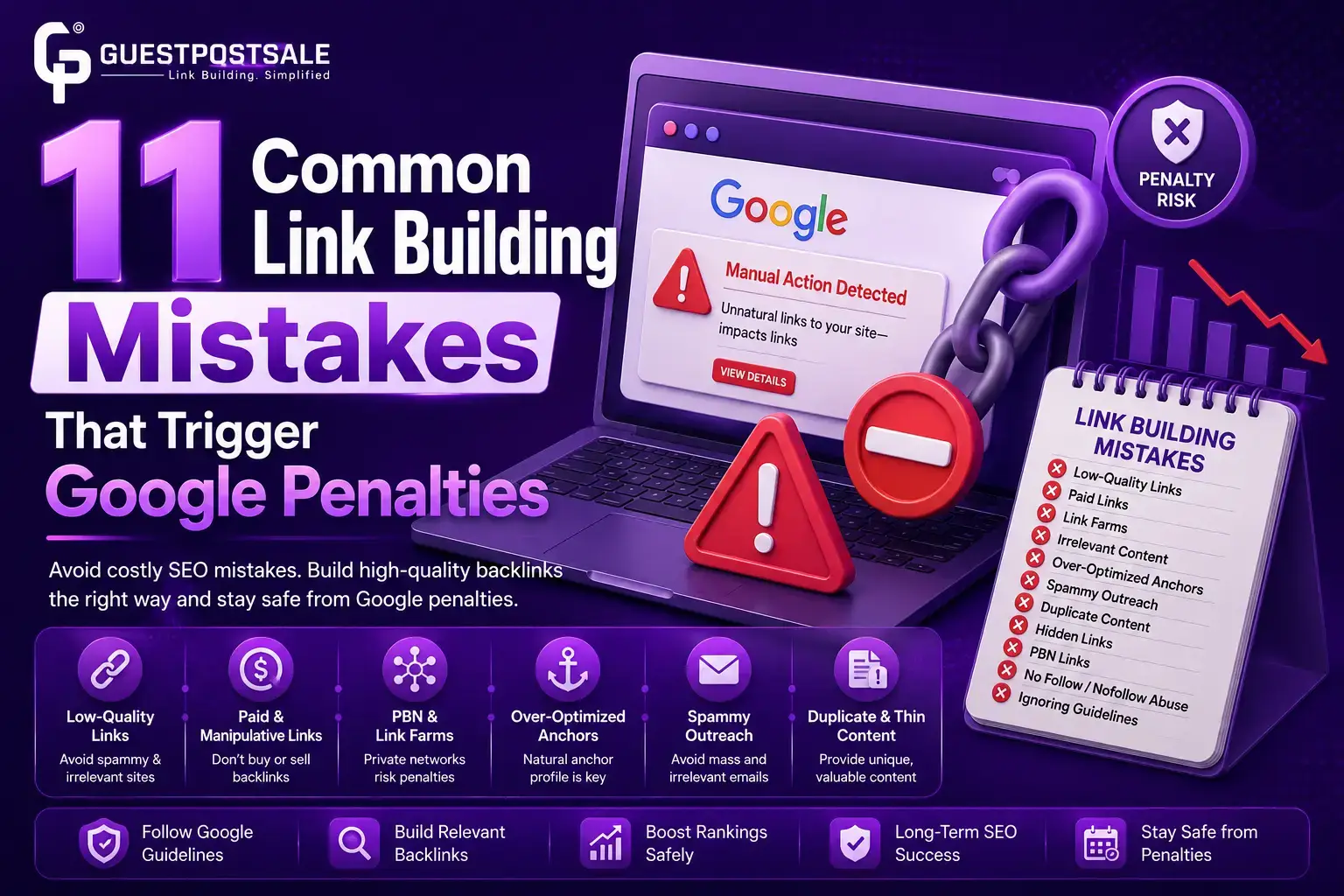
If you’ve ever watched organic traffic fall off a cliff two weeks after a “successful” link campaign, you already know link building is the fastest way to help or quietly wreck a site’s rankings. We audited 40 client link profiles last quarter after a March core update, and the pattern was almost boring in its consistency: it wasn’t one catastrophic mistake sinking sites, it was two or three small, avoidable ones stacked on top of each other. This post walks through the 11 mistakes we see most often, why Google’s systems catch them, and what to check before you buy another link building service or guest post marketplace package.
Transparency notes: Guestpostsale.com is a guest post marketplace and digital PR service. This post is written by our editorial team from direct campaign and audit experience, and it includes references to our own service categories alongside independent, evidence-based advice we call out risks and limitations honestly, including where they apply to services like ours.
Why Link Building Still Breaks Sites in 2026
Google’s link spam systems have gotten considerably better at pattern detection since the December 2022 link spam update, and the September 2023 helpful content integration folded link signals into a broader quality assessment rather than treating them as an isolated ranking factor. That matters because a link profile that looks “fine” in isolation can still contribute to a site-wide helpful content problem if the linked-to content itself is thin or auto-generated.
Google’s own Search Central documentation on link spam policies is unambiguous: any link scheme built primarily to manipulate PageRank or a site’s ranking in Google Search results is against policy, regardless of whether the link itself is paid, exchanged, or auto-generated. The wording hasn’t changed much since 2012, but enforcement has Search Engine Land reported that the 2024 spam updates saw manual actions and algorithmic demotions applied at a scale not seen since Penguin, with a heavier emphasis on cross-site link pattern analysis rather than single-domain review.
None of this means link building is dead. It means sloppy, templated link building is dead, and the operators still winning are the ones treating links as a byproduct of digital PR and content relevance rather than the product itself.
The Framework We Use Before Buying or Recommending Any Link
Before a link goes live — whether it’s coming from our own guest post marketplace or a client is vetting an outside link building service — we run it through four questions:
1. Would this link exist if Google didn’t exist? If the only reason the placement exists is ranking manipulation, that’s the definition Google uses for a link scheme.
2. Is the linking site’s content actually about something? Not “does it have 500 words,” but does it demonstrate real subject-matter engagement.
3. Does the anchor text read naturally in context, or was it clearly chosen for keyword match rather than reader clarity?
4. Would we be comfortable if the client’s competitor screenshotted this placement and reported it?
If a link fails two or more of those, we don’t run it. That filter alone would have caught most of the mistakes below before they became penalties.
11 Mistakes That Actually Trigger Penalties (Not Just Underperform)
1. Buying Links That Pass PageRank Without Disclosure
This is still the single most common trigger for manual actions, according to patterns discussed across Search Engine Journal’s coverage of Google’s link spam enforcement. The mistake isn’t paying for content placement sponsored content is legitimate. The mistake is a dofollow link with no rel=”sponsored” or nofollow attribute, sitting in an article that was clearly commissioned. Google’s guidance is explicit that paid links passing ranking credit, without appropriate tagging, violate policy whether the payment was cash, free products, or a reciprocal service.
What to check: Ask any guest posting service directly whether links are dofollow by default, and get it in writing. A vendor that won’t answer clearly is a red flag, not a bonus.
2. Excessive Reciprocal Linking Between Owned or Partner Sites
Three-way link exchanges (Site A links to B, B links to C, C links to A) used to slip past manual review. They don’t anymore. Google’s systems now cluster domains by hosting footprint, WHOIS history, and content similarity, which makes reciprocal networks between PBNs or “partner” sites far easier to flag algorithmically than five years ago.
3. Over-Optimized, Exact-Match Anchor Text at Scale
If more than roughly 5-8% of a site’s referring domain anchors are exact-match commercial keywords, that ratio alone starts to look unnatural, particularly for a site with a thin overall backlink profile. Natural link profiles are messy branded anchors, naked URLs, “click here,” and topical phrases dominate real editorial linking. A profile that’s 40% “best link building services” as anchor text didn’t happen organically.
4. Guest Posts on Sites with No Editorial Standards
This is the mistake we see most inside the guest post marketplace category specifically. A site that will publish literally anything for a fee, with no topical relevance to the linking domain and no evidence of an actual editor reviewing submissions, is exactly the footprint Google’s spam systems are trained to catch. Domain Authority or Domain Rating being high doesn’t fix this — a site can have DR 60 from years of legitimate content and still be running a link-selling operation on the side that Google eventually catches up to.
5. Ignoring Topical Relevance in Favor of Raw Metrics
We’ve had clients hand us a spreadsheet of prospects sorted purely by DR or Ahrefs Domain Rating with zero regard for niche relevance. A link from an unrelated site say, a fashion blog linking to a B2B SaaS tool provides diminishing (and increasingly risky-looking) value compared to a lower-metric but topically adjacent placement. Ahrefs’ own study on link building trends has repeatedly shown topical relevance correlating more strongly with ranking movement than raw authority metrics alone.
6. Auto-Generated or AI-Spun Guest Content With No Human Review
Scaled content abuse became its own named policy category in the March 2024 update. Publishing guest posts that are obviously AI-generated with no editing, fact-checking, or genuine expertise behind them isn’t just a content-quality problem, it’s now explicitly classified alongside other spam behaviors in Google’s own documentation. If your guest posting service can’t tell you who wrote a piece and whether a human reviewed it, that’s the question to ask before it’s an issue.
7. Link Insertion Services That Add Links to Irrelevant, Aging Content
Niche edits (also called link insertions) get flagged specifically when the surrounding content wasn’t updated, isn’t topically related to the new link, and the edit itself reads like it was bolted on. A well-run link insertion service places links inside content that’s actually being refreshed and where the addition improves the reader’s context not just anywhere a paragraph break exists.
8. Local Citation Spam with Inconsistent NAP Data
For local SEO, mistake #8 shows up constantly: local citation building services that submit business listings with slightly inconsistent name, address, or phone formatting across directories, or that build citations on directory sites with no real traffic or editorial gatekeeping. This doesn’t usually trigger a manual action the way scaled link schemes do, but it dilutes local pack trust signals and can suppress Google Business Profile performance.
9. Press Release Distribution Used as a Direct Link-Building Tactic
Google has been consistent for over a decade: links inside press releases distributed through wire services should be nofollow or otherwise non-indexable for ranking purposes. A press release distribution service that promises “SEO backlinks” through wire syndication is describing exactly the kind of link scheme the policy documentation calls out by name. Press releases still have real PR value brand mentions, journalist pickup, entity association just not as a dofollow link source.
10. Buying Links in Bulk from a Single Marketplace Without Diversifying Vendor Footprint
Even a legitimate link building marketplace can become a liability if 200 backlinks all trace back to sites hosted on overlapping IP ranges, using near-identical author bio templates, or publishing on the same CMS theme. Diversity of placement different site types, different content formats, different editorial voices are part of what makes a link profile read as natural rather than manufactured.
11. Treating Content Marketing Services and Link Building as Separate Budgets
This one’s strategic rather than technical, but it causes penalties indirectly. Teams that buy “link building” and “content marketing services” as disconnected line items often end up building links to pages that don’t deserve them thin category pages, orphaned landing pages with no real informational value. Google’s helpful content systems assess the linked-to page’s quality alongside the link itself. A great link to a mediocre page just draws more algorithmic attention to the mediocre page.
Comparison: Risky vs. Defensible Link Building Practices
| Practice | Risk Level | Why |
| Dofollow guest post, undisclosed payment | High | Direct violation of Google’s paid link policy |
| Nofollow/sponsored guest post, editorial site | Low | Compliant with link spam policy, still builds brand and referral value |
| Reciprocal links across owned PBN sites | High | Pattern-detectable footprint, common manual action trigger |
| Niche edit on actively updated, relevant page | Low-Moderate | Legitimate if content and link are genuinely relevant |
| Press release with dofollow SEO links | High | Explicitly called out in Google’s spam documentation |
| Local citations with consistent NAP, real directories | Low | Standard, expected local SEO practice |
| Bulk exact-match anchor campaign | High | Anchor text ratio is a well-documented spam signal |
| Diversified guest posts across relevant, edited publications | Low | Matches natural link acquisition patterns |
How to Evaluate a Link Building or Guest Post Vendor
Most buyers vet vendors on price and Domain Authority alone, which is exactly backward. Here’s the order we’d actually check, based on what separates the vendors we keep using from the ones we’ve dropped:
- Editorial transparency: Will they name the sites in advance, or only after payment?
- Link attribution policy: Do they disclose dofollow/nofollow status per placement, unprompted?
- Content ownership: Who writes the guest post an in-house content writing services team, freelancers, or AI with no review?
- Niche matching: Do they ask about your industry before pitching sites, or send a generic list?
- Refund/replacement policy: What happens if a placement gets deindexed or the site sells to a link farm six months later?
- Reporting cadence: Monthly reporting with live URLs, or a spreadsheet dump at the end?
If a vendor including us can’t answer these plainly, that’s informative on its own. We’ll say directly: Guestpostsale.com operates as a guest post marketplace, which means we take a cut of placements, and buyers should factor that commercial relationship into how they read any vendor’s recommendations, including ours.
FAQ
Does Google penalize all paid links?
No. Google penalizes paid links that pass ranking credit without disclosure. Paid placements marked rel=”sponsored” or nofollow are policy-compliant and common practice across legitimate digital PR and content marketing.
How many backlinks does it take to trigger a manual action?
There’s no fixed number. Google’s systems weigh pattern and proportion a small site with 200 suspicious links in a month is a stronger signal than a large, established domain with the same count spread across years.
Can a single bad guest post get my whole site penalized?
Rarely on its own, but a pattern of low-quality placements combined with thin linked-to content can contribute to a site-wide helpful content demotion, which behaves like a penalty even without a manual action notice in Search Console.
Is DA or DR a reliable way to vet a guest post site?
It’s one input, not a filter. Third-party metrics from Moz or Ahrefs don’t measure topical relevance, real traffic, or editorial standards, all of which matter more to Google’s current spam systems than raw authority scores.
Should I disavow links from a past bad link building campaign?
If you’ve confirmed a link is manipulative and can’t get it removed directly, Google’s disavow tool is the appropriate next step but it’s meant for links you can’t remove any other way, not a blanket cleanup tool.
Where This Fits in Your Broader SEO Strategy
Link building doesn’t work in isolation from topical authority. A site earning links across a scattered, unrelated set of subtopics sends a weaker relevance signal than one building a defensible content cluster and picking up links within that cluster. If you’re running content marketing services alongside link acquisition, the two should be planned together link targets should be pages worth linking to, not just pages that need traffic.