
Guest posting services are under more scrutiny than they’ve been in years, and most of that scrutiny is deserved. Since the September 2023 Helpful Content Update rolled into Google’s core ranking systems and the subsequent spam updates in 2024, a huge share of “guest posting SEO” content got flagged not because it was AI-written, but because it was written for search engines instead of people. That distinction matters more than almost anything else in this piece. If you’re running guest posting services online, ordering guest post packages from a provider, or writing the placements yourself, the question isn’t “can I use AI” you can, and almost everyone already does to some degree. The question is whether the finished piece reads like it came from someone who has actually done the thing it describes.
We work inside a guest post marketplace, so we’ll say the quiet part up front: this is partly a pitch for using Guestpostsale.com, and we’d rather you know that going in than pretend this is neutral. What follows is still the same process we use internally when a client’s placement gets rejected by a target site’s editor or, worse, gets hit by a manual action after publication.
Why This Question Got So Much Harder in 2024–2026
A year ago, “does Google detect AI content” was the wrong question. Google has said repeatedly, including in its own Search Central documentation on AI-generated content, that its systems reward content quality and usefulness regardless of how it’s produced not the production method itself. The actual risk was never the AI. It’s what scaled, low-effort production tends to look like: near-identical structure across hundreds of guest posts, generic advice with no evidence behind it, and link placements that exist purely to pass anchor text rather than to inform anyone.
What changed is enforcement. Search Engine Land and Search Engine Journal both covered the March 2024 core update alongside a parallel spam update explicitly targeting scaled content abuse, and the practical effect for guest posting was immediate: sites that had been accepting bulk, templated contributor content in exchange for dofollow links saw those pages deindexed or devalued, and in some cases the linking domains lost authority across the board, not just on the offending pages. We saw client placements on a handful of “guest post friendly” niche sites drop out of the index within two weeks of that update. Nobody warned us. That’s the risk profile you’re actually managing now.
What “AI-Assisted” Should Mean in Practice
There’s a useful distinction the industry still argues about: AI-assisted versus AI-generated. In our process, AI-assisted means a model helps with structure, first drafts, research synthesis, and editing but a person with domain knowledge supplies the specifics: the anecdote, the number, the opinion, the thing that couldn’t have been invented by pattern-matching against a training set. AI-generated, in the pejorative sense people mean when they complain about “AI slop,” is when none of that human input ever happens and the piece ships as-is.
The mechanical tell for the second category isn’t vocabulary it’s variance. Genuinely useful writing has uneven paragraph lengths, a point of view that occasionally contradicts a competitor’s take, and small imperfections a model trained to be maximally agreeable tends to smooth over. If every paragraph in a guest post runs three sentences and every list has exactly three items, that’s not a coincidence; it’s a production shortcut, and editors who review a lot of pitches notice it within a few lines.
The Practitioner Framework: Five Passes Before Anything Ships
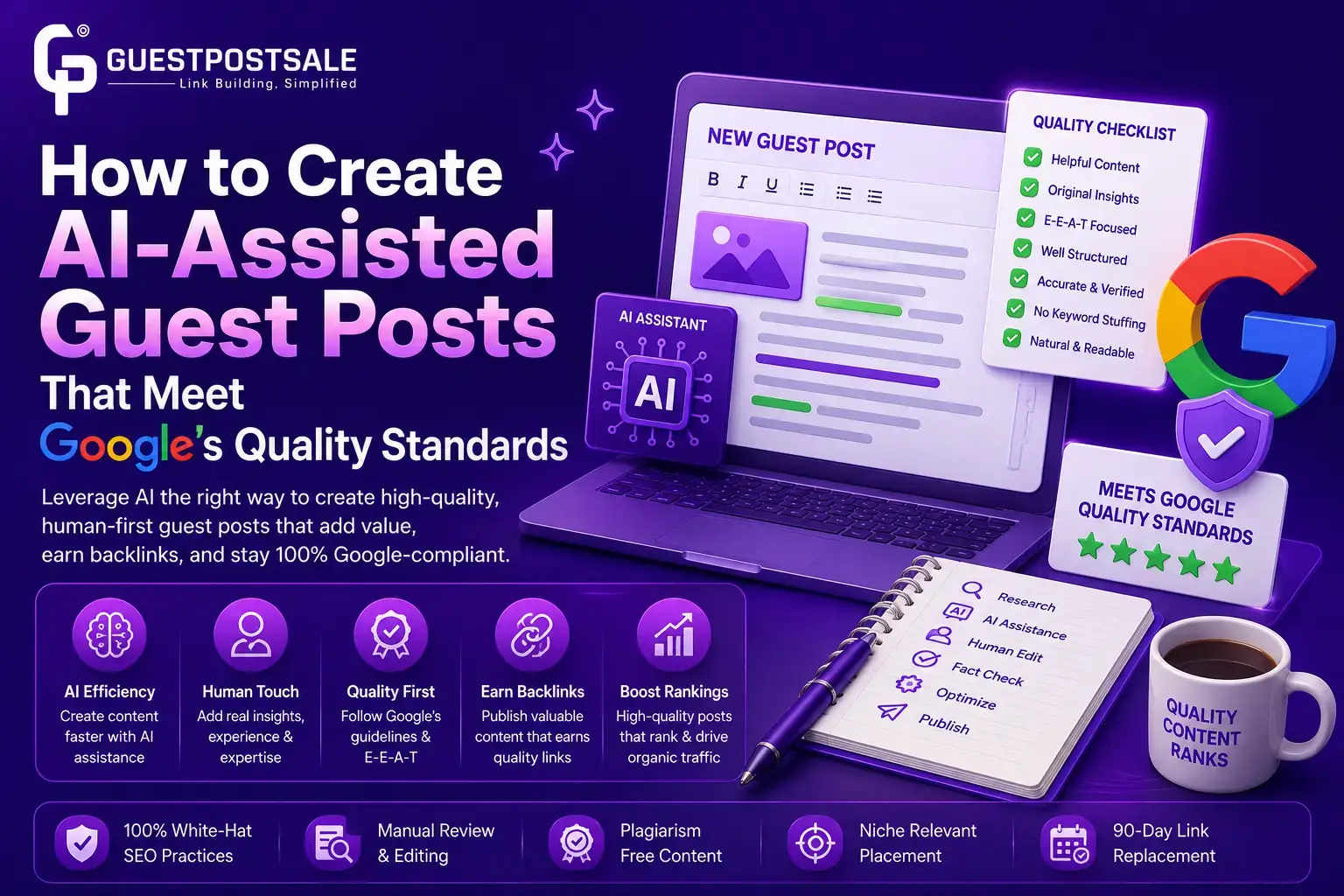
We run every AI-assisted guest post through five passes before it goes to a target site. This isn’t theoretical it’s the checklist our writers use, adapted here so you can run it yourself.
Pass 1 Intent and audience fit. Before a word is written, confirm the piece answers what the target reader actually searched for, not just what the keyword implies. A post targeting “guest posting SEO” written for a beginner audience needs different depth than one aimed at agency buyers evaluating vendors.
Pass 2 Draft with a real source of expertise in the loop. Use AI to structure and draft, but the input has to include something a practitioner supplies: a client result, a mistake you’ve seen repeated, a number from an actual audit. If you can’t fill that in, the topic probably isn’t one you should be publishing on yet.
Pass 3 Fact and citation check. Every statistic gets traced to a real, named source. Every claim about how Google’s algorithm works gets checked against current Search Central documentation, not a 2019 blog post that’s since been superseded. This is the single most common failure point we see in outsourced guest post packages — invented statistics attributed vaguely to “studies show.”
Pass 4 Voice and variance edit. A human editor reads the draft out loud. Anywhere it sounds like it’s reciting a script, it gets rewritten. Formulaic triplets, hedge-everything phrasing, and transitional filler (“in today’s digital landscape”) get cut on sight.
Pass 5 Compliance and disclosure check. Confirm the piece doesn’t make unverifiable guarantees, correctly frames link attributes (more on that below), and discloses commercial relationships where relevant.
Skipping Pass 3 is how most AI-flagged guest posts actually get flagged not by an AI detector, but by an editor or algorithm noticing a claim that doesn’t hold up.
Common Mistakes We See in AI-Assisted Guest Posting
A few patterns show up constantly when we audit placements from other providers, or when a client brings us content a previous vendor produced:
- Treating Domain Rating or Domain Authority as the only quality signal, ignoring topical relevance, traffic trends, and spam score entirely.
- Describing all guest post links as if they carry equal or guaranteed dofollow link equity, when Google’s link spam policy explicitly expects sponsored or exchanged links to be marked nofollow or sponsored.
- Publishing the same core article, lightly reworded, across a dozen target sites a scaled-content pattern Google’s spam policies call out by name.
- Promising specific ranking outcomes (“guaranteed top 3”) in outreach pitches or on the published post itself, which damages trust with editors and readers alike.
- Zero mention of risk or nuance anywhere in the piece real guest posting has trade-offs, and pretending otherwise is itself a credibility signal, just a negative one.
How to Evaluate a Guest Posting Service Provider
If you’re the one buying guest post packages rather than producing them, the AI question becomes a vendor evaluation question. Here’s the comparison framework we give clients who are choosing between guest posting service providers.
| Evaluation Criteria | What to Look For | Red Flag |
| Content origin | Discloses AI-assisted or human-written process, shows editorial review | Refuses to explain how content is produced |
| Site vetting | Real traffic data, topical relevance, manual spam score review | “DA 50+” as the only stated qualifier |
| Link attribution | Transparent about dofollow, nofollow, and sponsored tags | Guarantees all links will be dofollow |
| Placement uniqueness | Fresh article written for that specific site and audience | Same article template reused across sites |
| Reporting | Live URL, indexation status, link attribute confirmed post-publication | No verification after “delivery” |
| Pricing transparency | Per-placement pricing tied to metrics you can verify yourself | Bundled packages with undisclosed site lists |
None of this requires avoiding AI-assisted writing. It requires a provider willing to show their work.
A Short, Honest Note on What AI Can’t Do Here
AI can’t have run the campaign. It can’t tell you that a client’s outreach response rate doubled after switching from generic pitches to ones referencing the target site’s last three published pieces that’s a detail from an actual account, and it’s the kind of thing that makes a guest post read as credible rather than templated. If your process doesn’t have a human supplying details like that, the AI-assistance question becomes moot, because the underlying content problem genuinely thin, undifferentiated writing was never about the tool in the first place.
FAQs
Does Google penalize AI-written guest posts specifically?
No. Google’s guidance states it evaluates content on quality and usefulness signals regardless of how it was produced. What gets penalized is unhelpful, scaled, or spammy content AI or human-written that exists primarily to manipulate rankings.
Should guest post links always be dofollow?
No. Under Google’s link spam policies, guest post links that were exchanged, sponsored, or otherwise arranged should generally carry a nofollow or sponsored attribute unless the linking site’s editorial team includes it on genuine merit, independent of the arrangement.
How long should a guest post be to rank well?
There are no fixed word count Google rewards directly. Depth should match what fully satisfies the reader’s intent some technical topics need 2,500+ words, while a narrow how-to answer might be complete at 900.
What’s a realistic AI-detection score to target for guest posts?
Under 10% is a reasonable practical target for most detection tools, though these tools are imprecise and false positives happen even on fully human-written text. Treat detection scores as a rough signal, not a pass/fail gate editorial voice and factual accuracy matter more.
Can I use the same guest post article on multiple sites?
Publishing near-duplicate content across multiple domains is flagged under Google’s scaled content abuse policy and risks devaluing every linking domain involved, not just the article itself. Each placement should be written for that specific site and audience.
Key Takeaways
- AI-assistance itself isn’t the risk; scaled, undifferentiated, unverified content is.
- Every statistic and algorithm claim in a guest post should trace back to a real, named, checkable source.
- Link attribution (dofollow/nofollow/sponsored) should reflect the actual arrangement, not a blanket promise.
- Evaluate guest posting service providers on transparency about content origin and site vetting, not just DR/DA numbers.
- The five-pass framework above is reusable for any AI-assisted content, not just guest posts.
Ready to See This Framework Applied to Your Niche?
If you’re weighing whether to build this process in-house or hand it to a provider that already runs it on every placement, that’s exactly what our guest post marketplace is built around. [Explore our guest post marketplace] to see vetted, niche-relevant sites, or [get a custom guest post plan] built around your target keywords and link profile.
GuestPostSale is a guest post marketplace and digital PR service connecting brands, agencies, and site owners with vetted publishers across a wide range of niches. The team works directly with clients on link building, guest posting, and press release distribution, with a focus on placements that hold up to editorial and algorithmic scrutiny over time.