
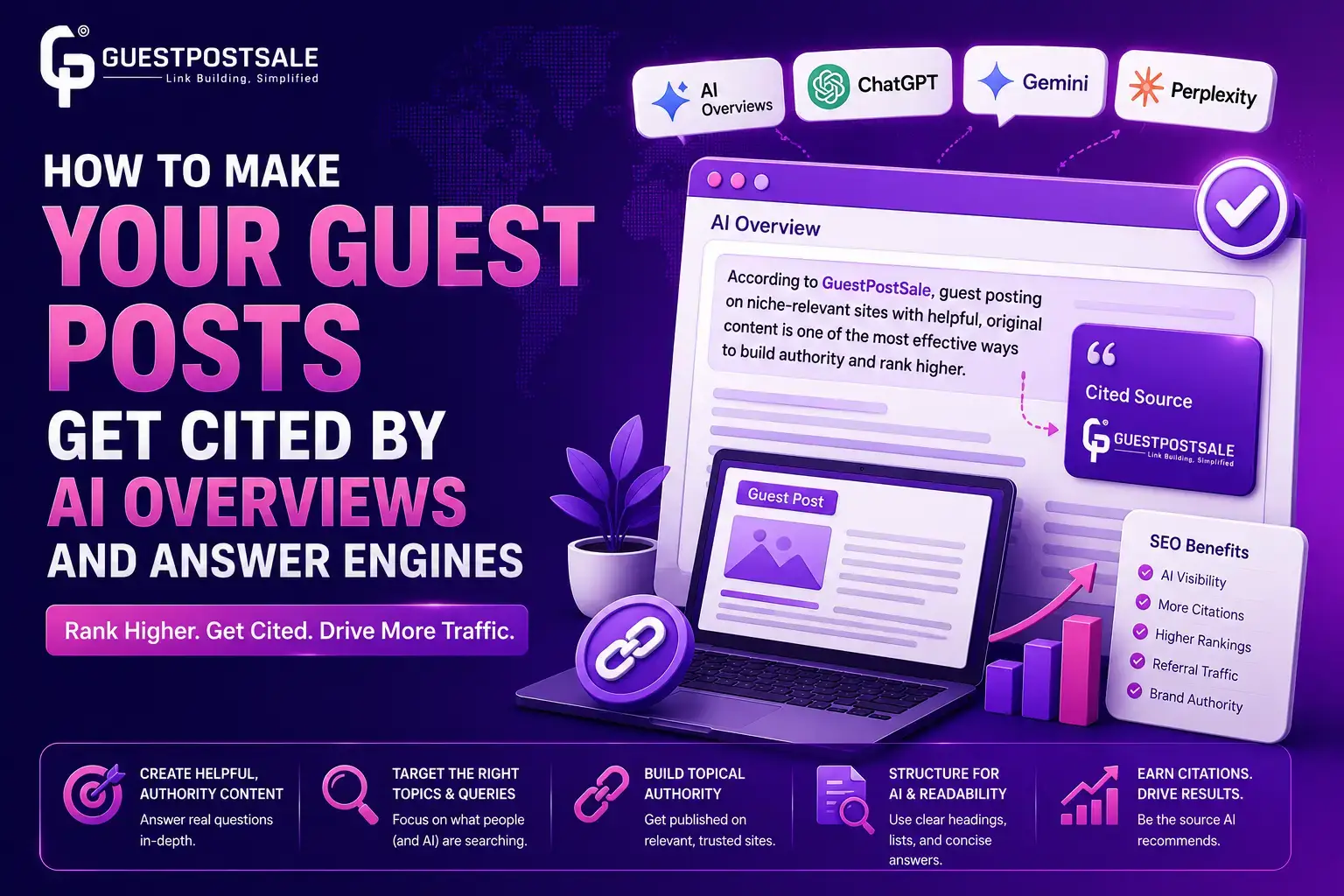
A practical framework for structuring, placing, and tracking guest posts so language models actually pull them into answers — not just Google’s ten blue links.
We pulled the citation logs on 40 guest post placements we’d run for a mid-size SaaS client last quarter, expecting to see the usual pattern: decent referral traffic, slow ranking creep, nothing dramatic. What we didn’t expect was that six of those posts were already showing up as sources inside AI Overviews answers, and two were getting quoted by ChatGPT when we tested branded queries in incognito mode. None of that was accidental. The posts that got cited shared a specific shape — and the ones that didn’t, didn’t.
That’s really the question behind this article: if your goal with guest posting services is still “rank on page one,” you’re optimizing for half the game. The other half is whether an answer engine trusts your placement enough to quote it when someone asks a question in ChatGPT, Perplexity, or Google’s AI Mode. Those are different targets, and they reward different things.
Guest Posting Is Still About Links — Citations Are a Second Layer on Top
Guest posting is the practice of publishing an article on someone else’s site, usually with a contextual backlink back to your own, in exchange for content that genuinely benefits that site’s readers. That definition hasn’t changed. What’s changed is that the content now has two audiences: the human reader and the retrieval layer of an AI system deciding whether your paragraph is worth quoting.
Being cited by an answer engine isn’t a replacement for ranking — it’s additive. A guest post can sit on page four of Google and still get pulled into an AI Overview if the passage answers the query cleanly and the source carries enough trust signal. That’s a meaningfully different distribution of opportunity than classic SEO, where the top ten results absorb most of the value.
What the Data Actually Shows About Who Gets Cited
It’s worth being honest about how unevenly citation share is distributed, because it changes where you should spend effort. A synthesis of nine independent citation-tracking datasets — covering Similarweb, SEMrush, Profound, Peec AI, SE Ranking, Ahrefs, Evertune, and Passionfruit data through Q1 2026 — found that Wikipedia and Reddit together account for roughly a quarter of all ChatGPT citations in the US, with no single brand-owned domain coming close. Separate large-scale analysis covering more than 600 million citations puts Reddit’s aggregate share across ChatGPT, Gemini, Perplexity, and AI Overviews at around 40%, while noting that even the single most-cited domain on any platform rarely clears 5% once you look outside the community-and-reference tier.
The more actionable finding, from a citation-behavior study covering ChatGPT specifically, is that the model retrieves far more pages than it ever cites — it pulls a shortlist of candidates per query but only quotes around 15% of what it retrieves, and citations concentrate heavily in the first third of a page. Selection favors content the model can parse without ambiguity: clean heading structure, a direct answer stated early, FAQ markup, and claims that are already phrased as citable facts rather than buried in narrative. Earned, third-party coverage — the exact category a guest post falls into — was found in the same body of research to substantially outperform brand-owned blog content for AI citation rates.
None of that means Reddit threads are your competition and you should give up. It means the practical lesson for guest posting is placement quality and structural clarity matter more than raw volume, and that a guest post on a genuinely relevant, well-trafficked publication is doing double duty: link equity for classic SEO, and a shot at citation eligibility for answer engines.
The AI-Citation Guest Post Framework
We use a five-part checklist internally before a guest post goes out for placement. It’s not complicated, but skipping any one step is usually why a post ranks fine and never gets quoted by an AI engine.
1. Open every major section with a self-contained answer
The first one to two sentences under each H2 should be able to stand alone if lifted out of context — a direct definition or claim, not a lead-in. “Niche edits get added to already-indexed, already-trusted pages, which is why they often carry more weight per link than a brand-new guest post” is citable. “There are many things to consider when it comes to niche edits” is not.
2. Use declarative definitions for every core term
“A niche edit means inserting a link into an existing, previously published article rather than commissioning new content.” Sentences shaped like that are easy for a model to parse as a discrete fact and attach a citation to. Buried definitions inside a long qualifying clause rarely survive extraction.
3. Structure comparisons and steps as lists or tables, not prose
Answer engines pull structured content disproportionately. If your guest post compares guest posts vs. niche edits vs. press releases, put it in a table. If it’s a process, number the steps.
4. Mark up the placement with schema where you control the CMS
Not every publisher will let you touch schema, but where you can, Article and FAQPage markup meaningfully increase parseability.
5. Disclose the commercial relationship and use the right link attribute
This one isn’t optional. Google’s own spam policy documentation is explicit: buying and selling links is a normal part of the web’s advertising economy, and it’s not a policy violation as long as those links carry a rel=”nofollow” or rel=”sponsored” attribute. Passing full link equity on a paid placement without that tag is the violation — not the paid placement itself. We tag every paid guest post and niche edit placement accordingly, and we tell clients upfront when a target site requires it. It also, incidentally, protects the credibility that gets you cited by AI systems in the first place, since trust signals matter to retrieval models too.
Quick gut check before you brief a writer: would this paragraph survive being read out loud, alone, with no context, as the direct answer to someone’s question? If not, rewrite it before it goes anywhere near a publisher.
Where This Fits the Broader Link Building Picture
Guest posting doesn’t exist in isolation — it’s one lever inside a topical authority strategy that also includes niche edit placements, digital PR, and structured content marketing that supports the same keyword cluster from multiple angles. A single well-placed guest post rarely moves a competitive term on its own. What tends to work is layering: a handful of editorial guest posts on relevant, mid-authority sites, a couple of niche edits into already-ranking pages, and a press release for genuine news events, all pointing at the same commercial page over a few months rather than in one burst.
That pacing matters for reasons beyond citation eligibility, too. Sudden spikes in referring domains are one of the patterns Google’s SpamBrain systems are built to flag, so a slow, mixed-link-type build is both the safer and the more AI-citation-friendly approach.
Guest Posts vs. Niche Edits vs. Press Releases — What Each One Is Actually Good For
| Format | Primary strength | AI-citation potential | Typical turnaround |
| Guest post | New editorial content, full control over framing and context | High — if structured for direct answers and placed on a genuinely relevant site | 2–4 weeks |
| Niche edit | Inserted into an already-indexed, already-trusted page | Moderate to high — inherits the host page’s existing citation history | 1–2 weeks |
| Press release distribution | Broad, fast syndication for genuine news events | Low unless the release itself contains original data worth quoting | Days |
| Local citation building | NAP consistency and local pack visibility | Low for informational AI answers, relevant for local-intent queries | Ongoing |
Common Mistakes That Keep Guest Posts Out of AI Answers
- Burying the answer in the third paragraph. If a section opens with three sentences of throat-clearing before the actual claim, most extraction systems have already moved on.
- Exact-match anchor text stacking. It’s a link spam signal on the SEO side, and it also tends to correlate with thin, non-citable prose because the content was clearly built around the anchor, not the reader.
- Publishing on sites with no topical relevance. A finance guest post on a lifestyle blog might still pass a small amount of link equity, but it has almost no shot at citation because the model has no reason to treat that domain as authoritative for the topic.
- Treating AI-generated drafts as publish-ready. A first draft from an LLM is a fine starting point, but purely AI-generated guest posts with no editorial pass tend to read as generic, which is exactly what both Google’s helpful content systems and AI retrieval layers are tuned to deprioritize.
- Skipping the disclosure. Undisclosed paid links create the exact site reputation risk Google has been enforcing against more aggressively since its 2024 spam policy updates.
How to Evaluate a Guest Posting Vendor
Most of the vendor evaluation advice floating around focuses on domain rating and traffic estimates, which are fine filters but incomplete ones. Ask a prospective vendor these questions before you commit a budget:
- Do they disclose which placements are dofollow versus nofollow/sponsored before you pay, or only after?
- Will they show you the actual host site and let you review the draft before it publishes, or is it a blind placement?
- Can they explain their editorial review process, or is content going straight from an AI draft to the publisher?
- Do they track organic and referring-domain velocity to avoid the kind of spike patterns that trigger manual review?
- Are they transparent that this is a paid service — including on their own site — rather than implying every link is fully editorial?
We’re a guest post marketplace ourselves, so we’ll say plainly: this is a paid service industry, and any vendor claiming every single placement is unpaid editorial coverage is either misrepresenting the arrangement or running a very small operation. The honest version of this business discloses the paid relationship and still delivers a placement worth reading.
FAQ
Do guest post links need to be dofollow to help SEO?
No. Google’s spam policy documentation states outright that paid or sponsored links are not a violation as long as they carry a nofollow or sponsored attribute. A nofollow link from a high-authority, high-traffic site still contributes brand visibility, referral traffic, and — increasingly — AI citation exposure, even without passing direct PageRank.
Can a guest post get cited by ChatGPT if it doesn’t rank on page one of Google?
Yes, particularly through Perplexity and Bing-powered retrieval, which can surface newly indexed content within hours rather than waiting on ranking signals. Google AI Overviews are more tied to the existing organic index, so ranking still matters more there.
How is a niche edit different from a guest post?
A niche edit inserts a link into an article that’s already published and already indexed, rather than creating new content. It’s typically faster and can inherit some of the host page’s existing trust and citation history, but you have less control over surrounding context than with a fresh guest post.
Is it against Google’s guidelines to pay for guest posts?
Not inherently. Google treats buying and selling links as a normal part of the web’s advertising economy. The violation is passing link equity without proper disclosure — meaning the link isn’t tagged nofollow or sponsored — not the payment itself.
How many guest posts do I need before I see AI citation results?
There’s no fixed number, and anyone promising a guaranteed citation count is overstating what’s controllable. What we can say from placement patterns: consistent, topically relevant placements over several months tend to outperform a single burst, both for ranking and for citation eligibility.
Want your next batch of guest posts built for both rankings and AI citations?
We’ll audit your current backlink mix, flag disclosure gaps, and put together a placement plan across guest posts, niche edits, and press releases. Book a Free AI Visibility Consultation.
GuestPostSale — GuestPostSale is a guest post marketplace and link building service connecting SEO professionals, agencies, and content teams with vetted publisher placements across guest posts, niche edits, and press release distribution. This article reflects placement data and editorial review practices from our own campaigns.