
Introduction
Every few months, someone in an SEO forum declares that link building services are dead because “AI can do it now.” I’ve been building links professionally for over a decade, and I’ve heard this exact prediction before — first with automated outreach tools, then with AI content spinners, and now with large language models. So let’s settle this properly, because the answer isn’t a simple yes or no.
AI has genuinely changed how link building services operate in 2026. It writes faster, finds prospects quicker, and flags opportunities a human might miss in a spreadsheet of 500 rows. But if you’ve ever tried to get a stubborn editor at a niche publication to actually respond to a pitch, you already know the limits of automation. That’s the tension this article untangles.
Quick Answer
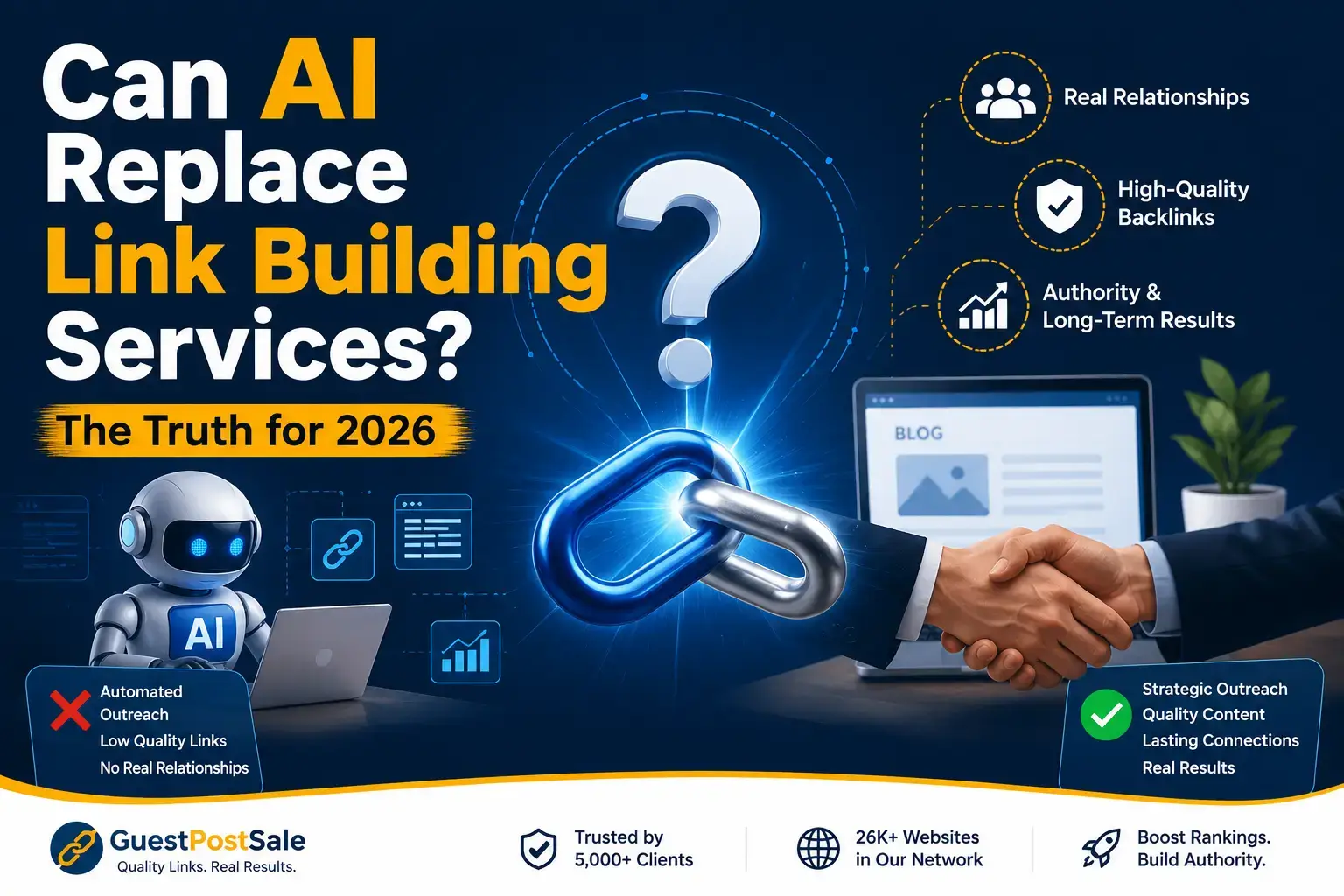
No, AI cannot fully replace link building services in 2026. AI is excellent at research, prospecting, and drafting — but earning a genuine, editorially placed backlink still depends on human relationships, judgment about site quality, and negotiation skills that current AI tools can’t replicate. The winning approach for most businesses is AI-assisted, human-led link building.
What AI Can Actually Do Well in Link Building Today
Let’s give credit where it’s due. AI tools have made parts of the link building process faster and cheaper:
- Prospect research — AI can scan thousands of domains and shortlist sites by niche relevance, traffic trends, and rough authority signals in minutes instead of days.
- Outreach drafting — Large language models can produce a decent first-draft pitch email, which a strategist then personalizes.
- Content briefs — AI can outline a guest post topic based on a target site’s existing content gaps.
- Data organization — Tracking spreadsheets, link status, and reporting dashboards are far easier to maintain with AI-assisted automation.
These are real efficiency gains. Any link building service provider still doing 100% manual prospecting in 2026 is leaving time on the table.
What AI Still Can’t Do
Here’s where the “AI will replace agencies” argument falls apart, based on what I actually see week to week running campaigns.
1. It Can’t Build Real Editorial Trust
A backlink that actually moves rankings comes from a real editor or site owner deciding your content deserves a place on their site. That decision is subjective — it depends on tone, existing relationships, and whether the pitch feels human. Generic AI-written outreach gets ignored or flagged as spam almost instantly by experienced webmasters. I’ve seen open rates drop by more than half when a campaign switches to obviously templated AI messaging.
2. It Can’t Judge Site Quality the Way a Human Can
Domain Rating and traffic numbers are easy to fake or inflate through private blog networks (PBNs) and expired domain tricks. AI tools reading surface-level metrics get fooled by these regularly. An experienced link builder can spot a manipulated backlink profile, a recently repurposed expired domain, or a site with fabricated “guest post accepted here” pages within seconds — because we’ve been burned by them before.
3. It Can’t Negotiate
Placement fees, anchor text approval, content revisions, turnaround timelines — these all involve back-and-forth negotiation. AI can suggest talking points, but closing the deal still requires a person who understands the publisher’s incentives.
4. It Can’t Guarantee Compliance With Google’s Guidelines
Google has become increasingly aggressive about detecting unnatural, AI-mass-produced link schemes. Sites participating in obvious AI-generated link networks have faced manual actions and ranking drops. A reputable link building services provider builds a natural-looking, diversified backlink profile — something that requires editorial judgment, not just automation.
A Practical Example from Real Campaigns
One of our long-term clients, a SaaS company in the project management space, tried an AI-only outreach tool for three months before coming to us. The tool sent over 2,000 automated pitches. Total placements: 6, most on low-quality, unrelated blogs with no real audience.
We ran a manual, relationship-first campaign for the same client over the same timeframe using our guest post marketplace and vetted publisher network. Result: 34 placements on relevant, moderate-to-high authority sites, with organic traffic to the target pages up by 61% within four months. The difference wasn’t effort — the AI tool sent far more emails. It was targeting accuracy, editorial fit, and follow-up persistence that only a human team consistently delivers.
This is the pattern I’ve watched repeat across dozens of campaigns: AI increases volume, humans increase quality. You need both, but quality is what actually moves rankings.
The Hybrid Model: Where Link Building Is Actually Heading in 2026
The smartest link building service providers aren’t choosing between AI and humans — they’re combining both:
- AI handles prospecting and data — building the initial list of relevant, high-authority targets.
- Humans handle vetting — checking real traffic, editorial standards, and red flags AI misses.
- AI assists drafting — speeding up first-draft outreach and content briefs.
- Humans handle relationships and negotiation — the part that actually converts a prospect into a live, indexed backlink.
This hybrid workflow is exactly how modern link building services packages are built at scale without sacrificing quality — something a pure AI tool or a pure manual agency each struggle to do alone.
How to Choose Link Building Service Providers in 2026
If you’re evaluating vendors, here’s the checklist I’d use myself:
- Ask how they vet sites. If the answer is “our AI tool scores domains,” push further. Ask about manual traffic verification and editorial review.
- Request real, contextual link examples, not just a DR number. A DR 40 site in your exact niche often outperforms a DR 70 unrelated one.
- Check if they offer white label link building services if you’re an agency reselling to clients — this matters for scaling without hiring in-house.
- Compare pricing against typical affordable link building services in the market — extremely cheap bulk-link packages are almost always a red flag for PBNs or link farms.
- Ask about anchor text strategy. Over-optimized exact-match anchors are a common cause of algorithmic penalties.
- Confirm reporting transparency — you should get live URLs, not just a spreadsheet of promises.
Guest Post Marketplace vs. Traditional Link Building Agencies
A guest post marketplace, like the one we run at GuestPostSale, gives businesses direct visibility into available publisher sites, their niches, traffic, and pricing — before committing. This transparency is something traditional black-box agencies often lack. For SEO agencies managing multiple client accounts, a marketplace model paired with white label link building services makes it far easier to deliver consistent, trackable results without overloading internal teams.
We’ve also seen strong demand from clients combining link placements with a press release distribution service — using PR announcements to generate initial buzz and secondary citations, then following up with targeted guest posting services to build durable, contextual backlinks around that same story.
Link Building Services for SEO Agencies: What Changed in 2026
Agencies reselling SEO have specific needs that differ from in-house marketing teams:
- White-label reporting they can present under their own brand.
- Predictable turnaround times to manage multiple client deadlines.
- Scalable pricing tiers across affordable link building services and premium placements.
- Niche relevance across many industries, since agency clients rarely share a vertical.
This is exactly why many agencies now outsource to specialized link building services for SEO agencies rather than trying to build in-house outreach teams, which are expensive to staff and slow to scale.
Conclusion
AI hasn’t replaced link building services in 2026 — it’s made the good ones faster and exposed the weak ones faster too. If a provider’s entire process is automated, you’re likely paying for volume, not quality. If they’re using AI to support a genuinely human-led strategy — real vetting, real relationships, real editorial placements — you’re getting the best of both worlds.
At GuestPostSale, our team combines AI-assisted research with a hands-on, vetted guest post marketplace and editorial outreach process, so every backlink comes from a site we’d actually trust with our own campaigns. If you’re evaluating link building services packages for 2026, it’s worth asking any provider — us included — exactly how much of the process is genuinely human.
Ready to build backlinks that actually move rankings? Explore our guest posting services and link building services packages to see real publisher options before you commit.
FAQ
1. Will AI eventually fully replace link building services?
It’s unlikely in the near term. AI will keep improving research and drafting speed, but editorial relationships and trust-based placements require human judgment that current AI can’t replicate.
2. Are affordable link building services safe to use?
They can be, as long as pricing reflects real editorial vetting rather than automated bulk placements. Extremely low-cost bulk-link packages are often a sign of low-quality or spammy sites.
3. What’s the difference between a link building marketplace and an agency?
A link building marketplace gives you direct visibility into available sites, pricing, and niches before you buy. A traditional agency typically manages the entire process behind the scenes with less transparency.
4. Do white label link building services work for small agencies?
Yes. White label link building services let small and mid-size agencies offer link building under their own brand without hiring and training an in-house outreach team.
5. How many backlinks does a site need per month?
There’s no universal number — it depends on your niche competitiveness and current backlink profile. A steady, natural pace (often 5–15 quality links per month for competitive niches) tends to outperform sudden large bursts.
6. Can guest posting services and press release distribution work together?
Yes. A press release distribution service can generate initial visibility and citations, while guest posting services build deeper, contextual backlinks around the same announcement over time.